
Back to the homepage – Hans-Georg Michna
German version of this page, Kenya 1980-2000 photos
Kenya travel reports: 1999, 2000, 2002, 2003, 2004, 2005, 2006, 2007, 2008, 2009, 2010, 2011, 2012, 2013-Goma, 2013, 2014, 2015, 2016, 2017, 2018, 2019
Kenya Safari Travel Plan
Last change 2024-01-20. Copyright © 1978-2023 Hans-Georg Michna
About this document
Safari Services
A Day in the Wilderness
A Travelling Day
Can I Stand It?
Children
Airline Flights
Preparations
Country and People
The Off-Road Vehicle
GPS
Rules
Flying
Camping
Photography
Health
Security
Cost
Nairobi
Naivasha
Nakuru
Baringo
Maralal
Baringo – Samburu direct, bypassing Maralal
Samburu/Buffalo Springs
Shaba, Meru, Kora (not in the normal itinerary)
Mount Kenya (not in the normal itinerary)
Samburu – Nairobi
Ukunda
Lamu
Kilaguni Lodge
Amboseli
Amboseli – Nairobi
Masai Mara
Serengeti – Ngorongoro Crater
Nairobi – Departure
General_Information_about_Kenya
Conditions of Entry
Hotel Prices
Car Hire and Prices
Nature Reserve Prices
Money
Mobile Phones
Internet Connection
Links
The main purpose of this document is to give free advice to travellers and some additional, specific information to those who want to do a self-drive safari in Kenya.
I also arrange such safaris from time to time for friends (not for profit), and this document is meant to prepare them for the trip.
If you want to plan your own self-drive safari or want to take part in one, please read this document thoroughly. It contains important information about your journey to Kenya. Please note that all information given in this document is without guarantee and could be wrong. You are responsible for yourself. This especially applies to all security and health questions and for fulfilling legal requirements when entering Kenya.
Please note that my Safari Services are currently, as of 2024 and possibly the next years, not completely available. Please ask for details.
You can also hire me as a guide or security advisor. In this case please send me an email and ask about my offers, but please be aware that prices are higher than those of the ordinary package tour. A rough estimate of the lower limit, using standard lodges, is $3,000 per week and per person plus the cost of the airline tickets plus $5,000 per week for the entire group.
Please note that these prices are for a professionally guided safari. If you travel on your own, your costs will typically be around $2,000 per week and per person plus the cost of the airline flight to and from Kenya. This is a pessimistic, worst-case, off-season estimate. For more details please see the chapter Cost below.
Your safari can be arranged with your choice of lodges, car sizes and, if you prefer not to drive all of the tours yourself, with experienced drivers. Self-driving is quite possible and is recommended for very active adventurers. If you prefer to relax, take a driver. You can still take to the steering wheel whenever you like.
Your safari can be geared towards wildlife photography or zoology and can include a visit to a zoological research project and a lecture by a researcher.
I am also available as a planner, security advisor, and guide for exclusive group and V.I.P. tours to east Africa and can advise security escorts and body guards on specific local risks.
Suitable airplanes are available for pilots, e.g. Cessna single-engine four-seaters with high wings and, because of altitude and high temperatures, powerful engines and constant-speed propellers. These airplanes can be piloted after a three-day (max.) bush flying course. If a pilot doesn't pass the final test flight and there is no other pilot in the group, a safety pilot can be taken along who acts as pilot in command, but nonetheless lets the safari participant fly, safety permitting.
The minimal requirement for pilots is the possession of a private pilot license for single engine land airplanes, including an English language radio operator license. Recommended is some flying experience in single engine airplanes with constant speed propeller and at least 100 hours as pilot in command. Without this there is an increased risk of failing the flying course and its final test.

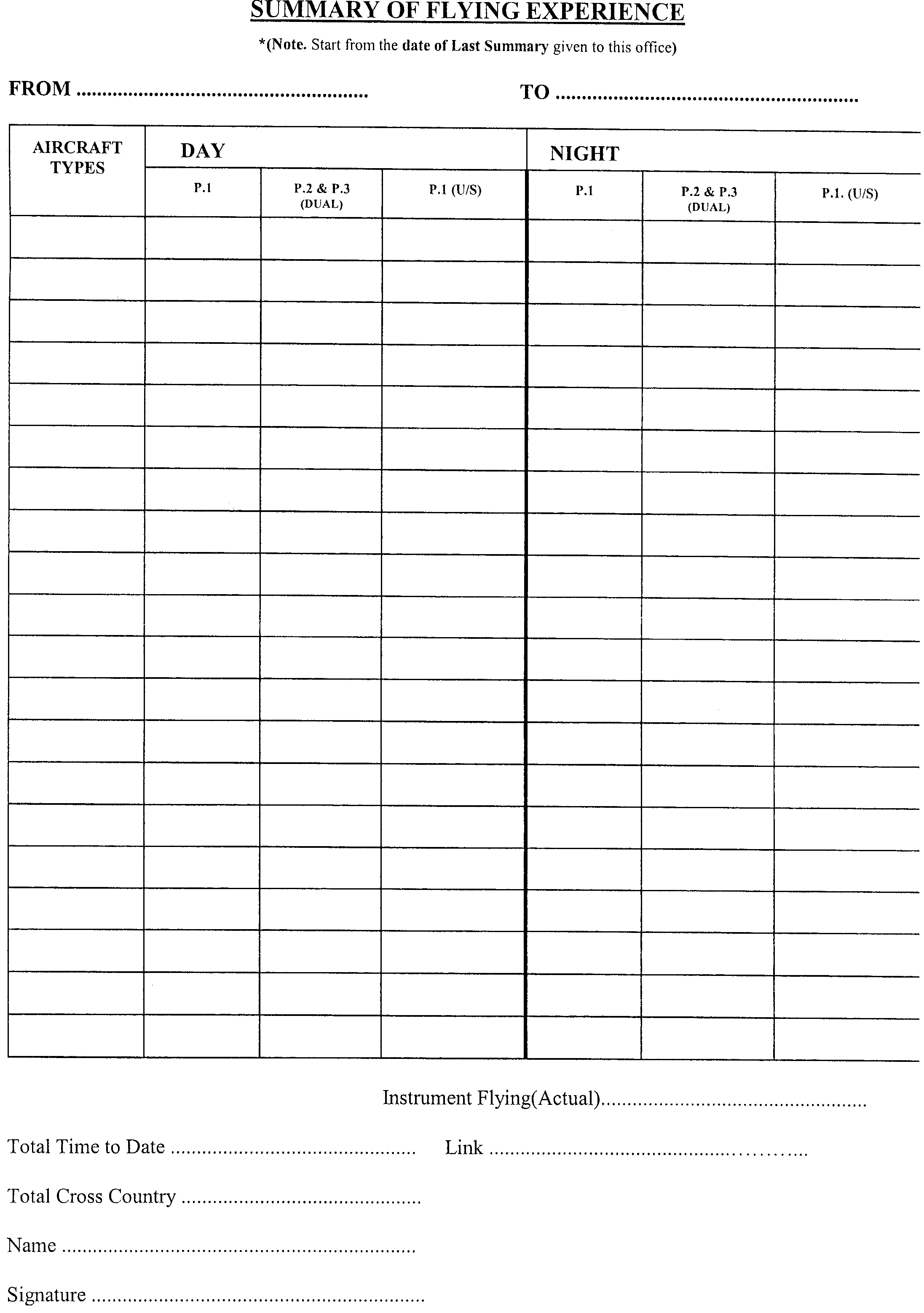
Forms: Foreign licence validation; Summary of flying; Self fly charter info
A flying safari works best when pilots are accompanied by a group, like family and friends, that uses at least one four-wheel-drive vehicle with some participants, taking turns as passengers in the aeroplane. The reason is that ground transportation is needed to drive the flyers to airfields and lodges, to do wildlife drives in the nature reserve, and to take the non-flying participants through the country.
The following descriptions of two days on safari are fictitious and do not reflect any particular route.
"Chai, Bwana!" ("Tea, sir!") Slowly I wake up and begin to understand that the black servant beside me is not a strange dream. Yesterday I had asked to be woken up this morning at 6 o'clock. Now the time has come. Perhaps I should rather sleep longer tomorrow!
I rise and dress, also donning the warm jacket, because it is still quite cool. I walk over to the room where more morning tea and coffee is served. It is still pitch dark outside. Only a pale-blue stripe on the eastern horizon announces the approaching day.
At 6 o'clock we walk out to the off-road vehicles, wipe the dew off the windows and windshield, turn the heating on to the maximum, and off we go, out into the wilderness. At first we drive with the headlights on, so we can see where we drive, but a few minutes later the sun rises above the mountains at the eastern horizon, beaming in bright yellow color, because the air is so clear, something which we almost never experience any more in our smog-infested industrialized countries back home.
We look out for vultures, which in turn look for successful other predators and their prey. In the distance we spot a vulture, heavily flapping its wings, without any updraft at this early, cool time. He flies at low altitude, trying to avoid being seen by yet more vultures. But another one is already flying in from another corner, apparently to the same destination. We try to make out the direction and follow them.
A quarter of an hour later we drive over a ridge and see a gruesome scene unfold before us. Two lionesses had hunted a gnu calf before sunrise and are still eating from it. A large number of vultures sit around around the lions at a safe distance. Many sit on nearby trees. New vultures fly in from all directions all the time.
We slowly drive closer to the lions, always at an angle, never directly towards them, and observe how they react to us. They do not react at all and are obviously accustomed to tourist cars. We drive to approximately 20 m beside the lions and watch them. One of our photographers says, "Could you drive three meters back and to the left? Then we would have the sun almost from the side." The driver obliges, then stops the engine again to stop the vibration to make sharper photos possible and, of course, to minimize the disturbance for the lions and for ourselves. Roof and windows are open, and I use the telephoto lens and polarizing filter. Another one tries to photograph the approaching and landing vultures with the help of a fast autofocus, which will also work out fine with these many opportunities.
A spotted hyaena approaches with his typical amble, but then sits down and keeps a respectful distance, not daring to come closer.
After a while the lionesses are totally full and can gain no more from the gnu calf. The remains now consist mostly of skin and bone. One of the two lionesses rises and trots slowly down the slope towards some shrubs. Shortly thereafter the other one follows. Almost before she leaves, the vultures all at once descend on the carcass, forming a hissing mountain of vulture wings. From further afield more vultures fly right into the middle and try to grab another bit of meat or at least skin or bone. Suddenly, only few seconds later, the hyaena enters the scene and jumps likewise into the middle on the vultures, which flutter up, frightened, and settle again in a circle around the carcass. The hyaena creeps into the thorax of the prey and pulls out a long thread of tissue. It almost makes me feel sick, but not so the vultures, which slowly move closer again.
The scene remains thrilling, until one of us notices that it is already after 8 o'clock and we will, like yesterday, miss breakfast if we don't reach the lodge until 9 o'clock. We decide to set a GPS waypoint on the place, so we can find it again, and have our own breakfast first.
Just before 9 o'clock, but still in time, we reach the lodge and hurry to the dining room. There's still some food left, and the waiters are already waiting for us with tea and coffee. I try the English breakfast, porridge (a kind of oatmeal cooked in water, with some sugar and in a ring of milk), then scrambled or fried eggs, small salty sausages, grilled tomatoes, beans in tomato sauce, bacon. After being active early in the morning this is not bad at all. Others prefer "continental breakfast", toast with jam. There are always some local fruits, papaya, melons, pineapple, green (but not unripe), fruity-tasting bananas, sometimes also a mango fruit.
After the breakfast some fanatic nature lovers drive again out into the bush to catch a few more photographs. Others are lazy, but some go out on a safari on foot through the savannah, led by an armed Maasai. A few branch off later to the swimming pool. I take photos of the baboons that pass through the lodge compound.
At noon there is a complete buffet meal. The incessant game drivers come back, again just in time, to get another share of the food, but if they missed it, it wouldn't be so bad—the next meal surely comes, and after each meal there is again tea and coffee.
After lunch all unanimously feel lazy. The sun radiates almost perpendicularly from above. It is warm. Most disappear into the reed-covered, airy and cool huts, read, clean their cameras, write postcards or a travel diary, or hold an early afternoon nap. Some sit near the river bank and watch the water and the butterflies, lizards, and birds, which keep appearing from the bushes. Only after 3 o'clock, when the sun has left the zenith, most feel lively again and get ready for a further game drive in the four-wheel-driven off-road vehicle. Three of our off-roaders drive off, on their daily afternoon game drive.
We visit the gnu calf again, of which nothing edible remains, and find only a few vultures in the nearby trees. We look once more, then want to drive on, when someone suddenly calls, "Look there!" He points to the group of shrubs, but we cannot see anything. The first car starts moving toward the shrubs. Only as we almost touch them, we see the whole lion pride in the bushes. There are nine, including three cubs. This time the male lion is there also. Except for the cubs all lie there with their eyes closed in the funniest positions, breathing heavily to get rid of surplus heat.
We stay with them taking photos for a while, then we drive on, this time towards the river. On our way we meet a group of giraffes, an enormous herd of wildebeest, zebras, Impala antelopes, Grants and Thompson's gazelles. We meet a hyaena in bright daylight, in front of its cave, looking at us suspicously before running away for a little distance, then stopping and looking at us again. Finally we come down into the river valley and now drive under trees and through bushes.
We reach the river, whose brown water rolls to the south between the sandy river banks. We get out of the cars and stand high on the steep bank. There in the middle of the water the head of a hippopotamus emerges, breathes, throws a look at us, snorts, and goes under again. Then still more pop up, to the left and to the right of him. The whole river is full of hippos. We move as little as possible and slowly sit down in the grass, positioning our cameras. After a while the hippos lose their initial shyness somewhat and emerge more frequently. Two big hippos get into a wrangling. The water sprays, and the others emerge to see what's going on. The cameras click to keep the scene.
After another while suddenly someone points far to the right at the other bank of the river. We look, but it takes us some time to spot what our friend is seeing. On the bank or the river lies a large crocodile, roughly four meters long. Through its colouring and total lack of movement it was so well camouflaged that nobody had noticed it the whole time.
Eventually we get up, back into our off-road cars, and drive some way along the river. We see a group of elephants, which end up plunging into the river from the other bank. We approach as closely as possible and photograph them. The scene is very beautiful. The elephants obviously enjoy the water. They drink, spray themselves and play for a while in the water. Then the matriarch (the oldest cow and leader) starts moving again. The others follow. Elephants don't have much time for playing. They must eat most of the time to nourish the large body. But again we could take a few unique photos.
We drive on and enjoy the almost indescribable beauty of Africa, our archaeological homeland. Around 6 o'clock the sun is low and seems to fall perpendicularly down to the horizon. We begin our trip back home and move slowly towards the lodge.
As we almost reach the lodge and again drive down to the river, the sun is just about to dip behind the horizon. "Stop!" somebody calls. "Could you please go back ten meters?" The driver goes into reverse. Now we also see what the attentive photographer had seen. The marching gnus on the ridge to our side walk right through the disk of the setting sun. The cameras are taken out once more.
At 7 o'clock we are back in the lodge. All disappear into their huts to reappear again at 8 o'clock in the dining room. Dinner is the main meal. There is a selection of different kinds of meat and an almost endless buffet. A corner is reserved for Indian meals, because in Kenya there are wealthy Indians, usually businessmen, who can also be found in the lodges, usually as guests, but also as employees, managers, or owners of the lodges (e.g. Lake Nakuru Lodge, Sundowner Hotel, Amboseli Lodge). Some of us try the Indian meals, which are very tasty, but also spicy hot.
After the meal a wildlife video is shown on the terrace, filmed by Alan Root, a white Kenyan, showing Africa in ways we cannot experience on our little journey. It shows, for example, the termite mounds, the meter-high chimneys we admired time and again on our travel, but it also shows them from the inside and explains the ways of life of their creators and their predators.
After the video we meet at the campfire and try some smalltalk with American and English tourists. Also a few other Germans just arrived and ask us about the lodge and our game drive. An Englishman tells us how he observed the hunt of two cheetahs in the evening, until nightfall forced him to return to the lodge. Quite tired, I sink into my bed around 10 o'clock and keep listening to the hunting calls of the hyaenas and the territorial calls of the nearby lion prides, but soon I fall asleep.
In the next morning our time in this lodge is coming to an end. We want to drive on and look at other areas. The distance this time is moderate, about 150 km on reasonably good gravel tracks, so that we expect a leisurely travel time of four to five hours. We want to drive off right after the breakfast, so that we have some daylight time still remaining at our destination.
We all sleep somewhat longer and meet at 8 o'clock for breakfast after packing most of our luggage and depositing our travel bags in the off-road vehicles. At 9 o'clock we take our remaining luggage to the cars. Four people fly with the airplane and have to be taken to the airfield, a small runway near the lodge. I volunteer to drive the fliers and their small flight luggage to the airfield. The heavier rest of their luggage remains in the car to keep the airplane light.
At the airfield the pilot checks the airplane, then the four climb in. The engine is started. At the other end of the runway a herd of gazelles emerges. I drive down the runway to chase them away. As I return, the airplane is ready for takeoff with the engine running and the taxi and landing lights switched on (which protects against bird strikes) on the gravel runway and waits for me to clear the runway. Slowly the engine winds up, to avoid damage from stones, and the airplane begins to roll. Twenty meters down the runway the engine reaches full power, and the little plane accelerates quickly. The passengers wave merrily. Already half way down the runway the small four seater airplane takes off and rises slowly up into the sky on a straightforward course. I drive back to the lodge, where everybody already waits for me, ready for departure.
Our way is a single track, partly sand, partly gravel, which can usually be driven quite well, so that we can drive between 30 and 50 km/h without feeling uncomfortable. We are not in a rush and enjoy the way as much as eventually the destination.
The landscape slowly changes its character. Impressive mountains appear and move past, "The Green Hills of Africa".
Because of the dust we drive at a distance of 300 to 500 m, but we try to keep the following car in the rear view mirror. One of the passengers suddenly says, "Where is the next car?" I look into the mirror and cannot see it either. I decelerate and wait to see whether they will emerge. Then I stop. The next car in front of us also stops. We wait one minute, then I turn around and go back. There they are, not even a kilometer behind us. The car is parked at the edge of the track, the roof opened, all look to the right. We carefully drive closer, then we see the reason of the delay—two cheetahs are sitting under a tree. We had overlooked them completely, just like the crew before us. Our first vehicle has also returned in the meantime and is stopping behind us.
The animals are beautiful. We stay there for quite a while, then we continue. On the way we come through a small town, where we have a short rest in the only "hotel" of the place, a shed, which, however, has a refrigerator. So we can drink some cold Sprite, Coca Cola, and mineral water and eat a few mandazis (sweet, round pancakes) and somosas (Indian folded pancakes with a spicy meat filling). The people are friendly and pleased about the little additional business and distraction. Some souvenir dealers descend on us and want to drag us into their stands, but we are already supplied and rather prefer to drive on.
Our way continues until we reach a tourist lodge with a runway right beside the road. There are our flyers with their airplane. They made an intermediate stop and spent some time in the lodge. We stop and describe our experiences. Two of the flyers are ready to jump into the car again. I would like to fly and take my small shoulder bag and camera box to the airplane. "Tanks full, badders empty!" says Hans-Georg, our pilot, and sends me over to the lodge bathroom, while the off-road vehicles are already disappearing in a cloud of dust on the horizon. We will very soon have caught up with them again.
I come back to the airplane, while the pilot, carefully as always, walks around the airplane slowly and checks all screws, flaps, hinges and examines the plane. I guess that is probably a good idea. After all our life depends on the little machine for the next hour.
I enter and sit down on the copilot seat. I should not step on the pedals, Hans-Georg explains to me. Moreover I receive another safety briefing for the case of a forced landing. I should not open the seat belt in the air (because of turbulence and of vultures). And still another obligation: I must always try to look out for vultures, which circle here in all heights and which we should rather evade, before they come in through the windshield. For that one must see them in time, and when the pilot looks on the map, then the passenger must watch out from the copilot seat. This is different from travelling in an airbus.
I get a pair of ear plugs offered, because the small, single-engine airplanes can be rather loud. I gladly accept them and stuff them into my ears. The noises around me change into a muffled murmur. The pilot checks all instruments and starts then the engine. After a few propeller revolutions the heavy six cylinder engine with its 235 hp springs to life hesitatingly, but then begins to run smoothly and evenly. The propeller already makes quite some noise, but then the folding window on the pilot's side is still open. "Don't you want to close that?" "Soon, it's still too warm in here." He should know. Probably the thing would fly with an open window as well.
We roll to the beginning of the runway. Our pilot tests the brakes and the instruments, then we roll onto the runway. The pilot closes his window and now gives full power. Now I notice what the ear plugs are good for. The thrust pushes me into the backrest, but I still have the camera ready and take photos through the side window during the takeoff.
We take off and fly in a gradual climb over the African landscape. Below us we see a herd of buffalos and far over there three red elephants. "This comes from the red soil." someone says. I can hardly take in all the impressions and take photo after photo. I'm glad I bought that bigger memory module before this safari, so I don't have to worry and can sort out the bad photos later.
From the air we have a marvellous view over the endless width of the east African savannah. We see a manyatta, a small nomad village with its circular thorn bush hedge, in which the domestic animals are protected from predators at night. Then we see the road again underneath, more precisely the dirt track. We follow it. After a short time we can already see our cars. The first has a aviation band receiver. We set the frequency and call our colleagues on the ground. Have they switched the thing on and set the right frequency? Yes, they stop and jump out of the car, while we fly by at low altitude. All cars stop normally on the left side in the driving direction. That was the agreed signal for everything being OK on the ground. Another curve—everybody waves—then we fly on in the direction of our far away destination. Over the radio we give yet another hint to the cars. Further in front is a branch, at which the cars should drive left. The way on the right continues into the wrong direction. We announce it, then we tune the transmitter back to the normal aeronautical frequency.
"You have control." our pilot tells me and takes his hands off the steering wheel. But I cannot fly! Hesitatingly I put the hands on the steering wheel. He holds my hands and shows me some steering movements. Actually, it's exactly as in a car. Left is on the left and right is on the right. Not as difficult as I thought. Apart from the fact perhaps that the entire aeroplane tilts into the curve.
I can also pull—then it goes up, or push, then it descends, and one gets a funny feeling in the stomach. After short time I steer the airplane as if I'd never done anything else. "Always keep the horizon horizontal", he says, and, "Steer a little bit more to the right, so we stay on course." In the meantime he looks at the map. I can only hope that he knows what risk he's taking.
In front of us, little points emerge in the air. I ask him: "What's that over there?" "Vultures, I take over." He grabs the steering wheel, while I release it, and he says the standard formula, "I have control." Some vultures are directly in front of us. The pilot makes a slight turn to the left before pulling up the plane to escape further vultures. After this sudden climb we go down again, almost like in a roller coaster. Strange feeling in the stomach. But that's probably normal here in Africa. "O.K., now it's up to you again. You have control."
Time passes quickly. We are already descending again, because far in front of us there should be the lodge, our destination for today. Slowly, we sink lower and lower, and I pull out my camera again. The pilot shows us the runway, to the left and in front of us. We have to turn once more, because the wind comes from our side, but we have to land against the wind.
We begin with the landing. Are all seat belts tight? Yes. The pilot aligns the plane with the runway. The landing flaps are down aready. We fly and sink slowly. Suddenly I see something on the runway and draw the pilot's attention to it. "I saw them too. We'll have to go around again." The landing flaps are retracted, and we fly only a few meters above the runway. Two zebras are standing there, in the middle of the runway at the far end. When we rush tightly over their heads, at full power, they run away quickly. Two turns later, we're landing, this time without any zebras. "Is this normal?" "Yes, it happens sometimes. I can't imagine why the creatures like these barren runways."
Leisurely we park the plane and secure it with stones against rolling away. Then we unload our luggage and sit down in the shadow under the wings. The zebras appear again. I get up and reach for the camera, when they suddenly gallop away. "Why?", I ask. "Well, they don't fear any vehicles, but they fear people." With us humans they have had bad experiences for a few millions of years. Cars or planes are instead considered to be some kind of harmless plant eater that never hurts them."
It doesn't take too long until the others come to pick us up for the lodge. We look back to our little white plane, which we leave alone and unguarded, before we direct our attention again at the landscape and the animals.
Early in the afternoon we reach the lodge and are welcomed by a small glass of cool fruit juice. Most of us look quite dusty. Also the bags are all in the same colour—reddish brown. We beat off the dust using some cloth, as well as we can, before we move into our huts.
Even today some of us haven't had enough action, so one hour later they get into their off-road vehicle again for an evening game drive. I prefer a little walk through the extensive lodge area and later write some postcards at the pool.
The dinner is at least as good as the one in the last lodge. On this journey, I won't loose any pounds, probably.
For an entirely healthy person the journey is not problematic at all. If you suffer from travelling sickness or any other illness, you should check if one of the stress factors described below could be a problem for you. In case you find something that may cause a problem, it is strongly recommended that you stand back and don't take part.
The following factors could be a problem for sensitive people:
The heat in Kenya remains within bearable limits. We are under the equator, but spend most of our time in the highlands. Nairobi and Masai Mara are chilly at night (lowest average day temperature in June, the coolest month in Kenya: 8°C/46°F) and only get warm during the day with direct sunshine. With full sunshine around noon, it can reach up to 30°C/86°F in the shade. Without any protection you cannot spend a long time in the sun without sweating heavily, but we normally do not do this. Baringo and Samburu lie somewhat lower and therefore are somewhat warmer than the highland, but still dry. The coast (Ukunda) is warm and humid, even at night. There you always sweat a bit. But even at the coast temperatures do not rise much above 30°C/86°F.
Especially in the highlands the sunshine is very intense, and it is very easy to get a sunburn. Therefore it is recommended to use sun screen, in particular on the face, nose, forehead, cheeks, neck, on the back of the hands, and also on the arms if you wear short sleeves.
In a closed car it gets hotter, especially when the sun is at its highest point at noon and shines on the roof from vertically above. The sun here has an intensity that is probably unknown in the higher latitudes of your home country. Due to this you should not stay in the stopped car during noon, but either get out of the car and sit in the shade or drive with open windows.
While driving you have to open a window to get cooled from the airflow. This airflow and the thin and normally dry air make the sweat evaporate very fast and make the heat bearable. In these temperatures you usually won't catch a cold.
Most of the days we will spend the time around noon between the large meals being lazy at the pool or in our rooms in one of the lodges. Only on the travelling days we probably have to drive at noon. We will only rarely be able to drive much faster than 50 km/h (31 mph), often even slower, such that the airflow remains tolerable.
If you sweat a lot, you have to drink a lot, which can irritate your digestion. The food is also not as clean as in an industrialized country, so you will experience some light diarrhea occasionally. Some people get a kind of light diarrhea from the heat, that occurs as a result of the body's involuntary precautionary storing of liquid in the bowels. If the body gets in a cooler situation for a few days, it apparently then tries to get rid of the unnecessary water and this can cause some light diarrhea as well, which is luckily not very uncomfortable or unpleasant.
The medicaments Metifex, Immodium, and similar ones seem to help against travel diarrhea. Who perceives a slight diarrhea as too unpleasant or is afraid of loosing weight should buy a pack of this or a similar medicament in a pharmacy.
The drives can be exhausting, because a few of the distances can take a whole day (with short breaks). The driving itself can be tiring, sometimes because of partly bad roads and sometimes because of being continuously shaken for hours. If you believe you will have physical problems because of that, you should think carefully about joining the expedition at all. The speed driven on these roads is a compromise between making headway, bumping, smashing, and zigzag driving. There is also the risk to end up with a broken axle after missing, or, more precisely, not missing a deep pothole.
Once you arrive at the lodge, there will not be any problems with the heat. In the midday heat you can relax in the relatively cool and airy huts, which usually have thatched, cool roofs, or you can spend your time in or at the swimming pool. The game drives (short drives in the off-road vehicles to see the animals) can be done in the morning or in the evening, when it is cooler. Only at the coast it is constantly warm and humid, even at night, but there are swimming pools and sometimes air conditioning and we will not start any exhausting tours from there.
Some places in Kenya are very dusty, especially Amboseli. So far this has only been a problem for persons wearing hard contact lenses. It is absolutely necessary for them to bring their glasses. Because of the dust, hard contact lenses are probably not usable during much of the journey, though some people have had good experiences with soft contact lenses. A dust allergy would also be a contraindication.
This journey is also nothing for late risers, but if the early sunset leads you to go to bed early you are not expected to have any problems.
Kenya can also be interesting for children. The dangers for children are usually overestimated, which certainly does not mean that children are at no risk at all. The main problems with children are the following:
In our experience, children have, even if they are quite young, a lot of fun on such journeys, although they are probably not as much interested in the actual attractions of Kenya. At a lot of places children will get price reductions, for example at the flight to Kenya they get up to 50% off (like with Egypt Air). This can also work in the lodges, if two small children can sleep in one bed, each with the head on one end.
Favorable flights change from year to year and are unpredictable. The most important questions are:
Some airlines used to offer students' tariffs.
Prices vary between €400 and €800 from Europe for economy return flights for one adult.
Flights can be booked on the KLM web site or with Travel Overland (www.traveloverland.de) directly through the Web:
Travel Overland head office: Barer Str.73, 80799 München
Booking telephone: 089-27276-300
Fax: 089-30798893
Email: tickets@travel-overland.de
On the Web site the flight data can be recalled.
Children get 50% discounts with several airlines like Egypt Air and Air France. Some others, like Alitalia, give a 40% discount.
The Kenyan departure tax was raised from $20 to $40, but is usually contained in the flight ticket price.
KLM and Kenya Airways on their flights to Nairobi in the economy class in 2009 and 2010 allowed two pieces of baggage of up to 23 kg each. KLM also has a pretty good and informative web site, allowing ticket purchase, online check-in, and often seat selection.
My experience on such international flights, particularly from Nairobi, is that a lot of stress can be taken out of the check-in procedure by being at the airport just 10 to 15 minutes earlier than needed. In Munich the rush seems to begin 90 minutes before departure, in Nairobi at least two hours. Be there before that rush and everything is a lot more relaxed.
On the flight you should get an immigration form and a customs declaration form. On request you should also get a visa application form, which you need if you do not already have a visa. Fill these forms during the flight, because you need them to waste no time at immigration or visa counters before you reach your checked luggage.
Some fields on these forms are unintelligible or ambiguous. If in doubt, just leave them empty. On the immigration form make an X in the box next to the label "Air".
After going through customs you leave the restricted area and face a bunch of people with signs, waiting for their clients. Here you can go a couple of steps to the left and use the Barclays ATM there to pull the maximum of KSh 40,000 from it. Since the machine offers only amounts up to 20,000 in its menu, the method is to select the universal account, cash withdrawal, type in the max. amout of 40,000, quickly remove and stow the card, then take the bundle of bank notes (thicker than 1 cm) and stuff it into your pocket without counting it. You don't want to stand in any open place in a developing country, counting a thick bundle of bank notes.
Unfortunately there have been cases in which the ATM did not provide the full amount. If you want to avoid this risk, order only KSh10,000 at once and keep repeating the withdrawal to get more money.
A taxi to town or to the Aero Club of East Africa on Wilson Airport is relatively expensive and costs approximately KSh 2,500. But if nobody collects you at the airport, it may be the next-best option.
Not everybody has to bring all items mentioned below. Sometimes you can share things with others, for example a malaria self test, a malaria cure (not everybody gets fever or even malaria on a short safari), GPS receiver, maps, water container, charger for rechargeable batteries, binoculars, etc.
The Kenyan currency (Kenya Shilling) may be imported or exported only in limited amounts. The conditions have been loosened, but in case of doubt you should inquire before the journey.
If you fly in a group, make sure everybody can recognize all the luggage for everybody in the group. The reason is that the first person who makes it through immigration should immediately go down to the luggage area and take the luggage, because there is a risk of luggage being stolen from the conveyor belt. One way of achieving this is to mark all luggage of the entire group with some unmistakable sign, the more conspicuous, the better.
Cross-check with another travel checklist.
First a basic remark on travelling in Africa. Most African countries are not as developed as the industrialized countries, so not everything will always work as you might expect, and you cannot always expect the same quality in goods and services. This, however, does not hold for the living beings in primeval nature, wherever it still exists. Life in Africa is more intense, often faster, and extremely impressive and admirable.
The typically African problems hamper every safari and are unavoidable. The only positive aspect is that they deter lazy visitors looking for convenience and therefore make the experience out in the bush more exclusive.
Lest anybody accuse me of racism, I don't see any indication that Africa's problems can in any essential part be traced back to genetic differences between human races. The reasons for the underdevelopment of Africa are instead described in the book "Guns, Germs, and Steel" by Jared Diamond and have nothing to do with human races. Africans are just like everybody else, and where they differ, they mainly do so because of debilitating conditions in nutrition, upbringing, and schooling and certain cultural deficiencies (like female genital mutilation, euphemistically called circumcision). But Kenya is developing fast, and I see a new generation growing up that is rapidly shedding these problems.
Here are only a few pieces of information especially on Kenya, which are important for driving a car and other contacts. If you are moving in the country freely, then you will inevitably come into contact with most diverse people. Because of the very different cultures and education levels these meetings do not always fulfill the expectations you may have brought along from your home country.
The first rule is that people who force themselves upon you should be avoided. In many cases these are tourist touts or souvenir salesmen, who only want to have your money. Normally they are unpleasant and sometimes even dangerous. If you need information or assistance, make sure you select the person, rather than letting any person select you. Keep the initiative and do not let it be taken from you.
Most citizens of Kenya are, as almost everywhere in the world, friendly and well-meaning. However, on the streets that are used by tourists you will find that many contacts are driven by the thought of earning a quick shilling, or a quick thousand shillings. You don't always have to give in.
Experience shows that Kenyan women are less affected by this phenomenon, so that it is easier to have a normal conversation with them. However they often do not know as much about more distant travelling destinations, because they do not travel as much as men do. Also, women in Kenya sometimes do not get a good education, so that they cannot speak English sufficiently, or they don't talk out of shyness or fear.
You have to consider that almost everybody in Kenya has to learn three or more languages and therefore many cannot be perfect in all of these languages. If you meet someone with whom you can converse well, then use this opportunity to get a better impression of the country and its inhabitants.
Take hitchhikers with you! You do not always have to do that and you can choose the ones that you feel comfortable with. First of all ask them whether they can speak English, because otherwise you will not be able to talk with them. For several reasons you should prefer women. You should also consider whether you can have a good conscience when you let a woman with a heavy bag and a sick child walk 20 km to the next hospital while you are driving the same distance comfortably and with free seats.
If you have something to eat with you, offer a bit to your passengers. That way you can often make your short term passengers happy.
If you take people with you who live in a traditional culture in more remote areas, then pay attention to the smell of these people. In our culture with a daily per head water consumption of one hundred and more liters, we are not used to body smell any more, but in hot and dry areas without water pipelines such a way of life is not possible. Many people living in dry tropical areas have to carry their water home every day from a distant water source (mostly the women), and that means that bathrooms or showers are not available. Instead they treat their bodies with different natural substances whose smell mixes with the normal human body smell and constitutes the characteristic smell of a certain culture.
If you arrive at the next lodge after such a journey and take your next warm shower immediately, at least try not to take it always for granted.
A phenomenon is the widespread theft. In Kenya it is a type of popular sport. You can be pretty sure that your bags will be opened and you have to consider that something may be stolen. Usually they try to do this in such an inconspicuous way that you will not notice it before your departure. That's the reason why you are continuously asked for your schedule, particularly when you are going to leave, because the last day, the morning before your departure, is particularly suitable for it. In order to avoid this, load your luggage into the car before breakfast.
Lock your bags in a certain manner, for example by leaving each zipper open one or two centimeters (half an inch). Then you can at least check whether your bags were opened, because this is usually done clumsily and is easy to discover. That your luggage remains perfectly undisturbed, despite the opportunity, is rather rare.
You may read Theft in Kenya for more details.
If you aim at winning an off-road race, this chapter will not help you. It is not about hardcore off-roading, but about how to reach your destination safely and comfortably, when you're travelling in a light to medium-sized four-wheel-drive off-road vehicle.
An off-road vehicle and its use differs from your normal car in some substantial respects. The typical off-road design specifics are:
Most off-road vehicles we use in Kenya have a roof that can be opened, so you can look out, standing on the seat or on a spare wheel, but do this only while standing still or while driving slowly. You can oversee the area better from above and for example see animals in the grass that cannot be seen by the driver and by seated passengers.
Both the driver and the people looking out through the roof hatch have to be very careful when driving near bushes and trees because branches, particularly those with thorns, can cause serious skin or even eye injuries. In Africa even a small skin lesion can, in the worst case, lead to a tropical ulcer, which can, in an even worse case, lead to the loss of an arm.
Therefore the driver should (a) drive slowly through bushy terrain, and (b) always warn his passengers, while the passengers should actively avoid contact with branches and should, if necessary, quickly duck into the car.
If you receive your off-roader, never rely on the car rental service for equipment and function. You must check the following things. Always take the time to do this! If you notice only with the first flat tire that the crank does not fit the jack, then you may have a big problem. Therefore:
I do not recommend to use a higher tire pressure than the prescribed one for the car.
Tire pressure plays a special role. It can be worthwhile to drive with low tire pressure because thus the tires can absorb a larger part of the vibrations at higher speeds. You can lower the pressure, depending upon type of vehicle and tire, down to about 20 PSI (pounds by square inch, 1.4 RKS, normal pressure is about 30 PSI). Unfortunately this also has some disadvantages:
So if you want to drive with low tire pressure, do it even more carefully and always brake immediately when you approach any rough patch in the road. But on some routes, particularly corrugated ones, the advantage outweighs the disadvantages, so a low tire pressure is recommended for those.
While the rattling and shaking due to corrugation is somewhat reduced at higher speeds, unfortunately the speed creates new problems of its own, particularly from holes and ditches across the road, but also from bends where you cannot see oncoming traffic and have to slow down. So you usually have to lower the speed often.
To drive stress-free (for both the car and the people) over corrugated roads, you can only drive slowly enough. There is always one speed that goes very gently over corrugation, but it is usually very slow, like 15 km/h. When you encounter strong corrugation or a combination of corrugation and other roughness, like stones or ditches across the road, you have to use this slow speed.
In small off-road cars like the Suzuki Sierra and particularly the Suzuki Maruti Gypsy you can have the rear seats removed, so can sleep comfortably in the car after sliding the two front seats far forward. In bigger vehicles, if the rear seats can be removed, you have even more space to sleep, but often the whole idea of having a bigger car is being able to carry more than two people, so everybody sleeping in the car is out of the question anyway.
Some off-road vehicles have a Diesel engine which requires Diesel fuel and can run in an emergency on similar light oils. All other cars require gas/petrol.
Range examples: The Suzuki Sierra used up approx. 8 to 9 l/100 km (11 to 12.5 km/l) and has a range of only approx. 400 km. The Suzuki Maruti Gypsy has a more modern fuel injection engine that uses less fuel. At absolutely optimal driving this off-roader can get close to 6 l/100 km (16.7 km/l) and can approach a range of 600 km. Larger off-road vehicles usually have a somewhat larger range due to their bigger tanks.
When driving in a developing country and being unsure of fuel availability, the rule is to fill the tank to the brim at every opportunity. It can also be useful to know where the last fuel station is before driving a long distance without any fuel stations. In Kenya I recommend to fill the tank whenever it is less than half full, except if there is already information on a fuel shortage.
All time estimates are valid only for a slow, careful and defensive way of driving. A suitable speed is 40 to 50 km/h (25 to 30 mph) on rough roads and generally not faster than 80 km/h (50 mph).
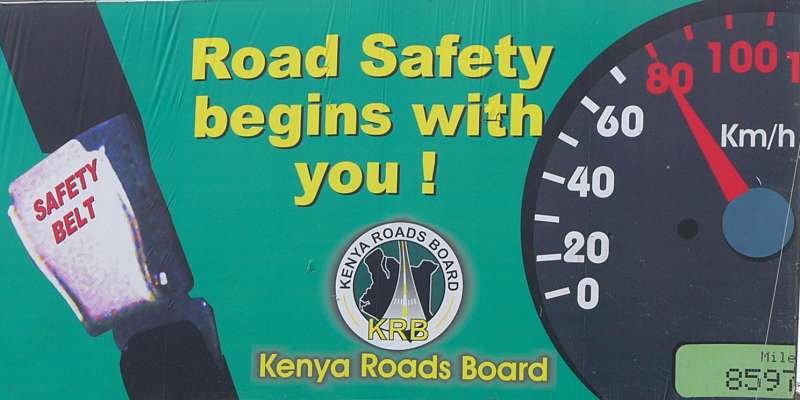
The Kenya Roads Board is right.
Reasons for these seemingly low speeds are:
Reduce your speed below 80 km/h when bushes or high grass are next to the road, because goats, sheep, cattle, and dogs can suddenly run onto the road. Also reduce the speed immediately when you see a change in the road surface ahead, because it could be a pothole.
Always guarantee that you reach your overnight stop before darkness falls (i.e. absolutely before 7 p.m. in Kenya). Reasons:
Dawn begins at 6 a.m., the sun rises at approximately 6:30 a.m. At 6:30 p.m. the sun sets, and around 7 p.m. it rapidly becomes pitch dark. Avoid all movement in the dark outside your accommodation. Remember also that you need some buffer time, for example, to change a wheel, and still arrive before nightfall. One hour is about the minimum for that.
Learn before the journey how to change a wheel. You will almost certainly need this ability. The most important points are:
On paved roads the main problems are:
For these reasons don't drive too fast, even on good paved roads, but at most 60 km/h and on very good roads at most 80 km/h. Do not let yourself be influenced by the fact that some natives drive substantially faster. Some Kenians joyfully take risks.
On sand and gravel tracks the problems are somewhat different:
In each case you must brake before the obstacle, if necessary with full force, blocking all wheels. Immediately before you roll into a pothole or a ditch, you must, however, release the brake pedal, for two reasons:
Each surface is different, so that you must try again and again to find an optimal driving fashion. Often, but not always, it is favourable to drive beside the track. Sometimes one can avoid corrugated surfaces by driving something to the side on the flanks of the track. If you must drive a longer corrugated distance, try different speeds, under otherwise good conditions up to 70 km/h. If shaking and rattling do not become worse, then you are better off this way, because at least you cover the same distance in a shorter time. But you do not overdo it, because each car eventually breaks, and you don't want this happening to yourself.
If the roughness becomes too severe, you may have to drop your speed all the way down to 20 km/h (bicycle speed).
Driving along tracks while it is raining or shortly after it has rained presents some very special challenges.
As long as you're driving on stony ground, there are hardly any problems, as the stones provide sufficient grip even when you drive through puddles. Even sand can often be negotiated, as long as the grains are big enough and not microscopically small, such that the rainwater filters through it.
The problems begin when there are too few stones on top of the mud or no stones at all and when the soil is soft, muddy, and slippery. Of course it is impossible to drive through any considerable stretch of soft, deep mud, but typically you are following car tracks indicating that the track has been drivable and driven on before.
A typical situation is that tracks have been reinforced by depositing gravel. However, the stones often disappear into the mud during rainy seasons, and you have stretches of slippery mud on a harder base, either stones or ground that the rainwater has not reached.
On such roads you can drive at varying speeds, usually between 20 and 40 km/h (12 to 25 mph). You have to concede, however, that every puddle can hide a deep hole, so you should not go too fast through puddles.
Another typical characteristic is a graded track that is convex in shape and thus has relatively deep ditches on either side. Here your biggest risk is sliding off to one side and ending up in the ditch where the wheels might sink in deeply and have too little grip to get out again.
Therefore you have to drive in the middle, on the top, preferably in older car tracks, even if those are already dug in somewhat deeply, like 20 cm (8 inches). Often there are stones underneath the mud, otherwise no car could have driven through. By looking at the older tracks you can usually tell whether and where other cars have got stuck before. If you don't see such spots, the track is probably safe to drive.
In this situation it is very important to keep an optimal speed. Drive too slowly, and you don't have enough momentum to negotiate short, difficult stretches, but drive too fast, and you run the higher risk of losing control of the car when, for example, the rear wheels slip off to one side, and the car slides uncontrollably into one of the ditches on either side. The optimal speed here is around 20 km/h (12 mph), depending on circumstances. 30 km/h (19 mph) is certainly too fast.
I experienced this in one incident where the rear of my off-road vehicle slid off to the right side in a gentle curve so far that the steering reached the stop and I could no longer compensate. After the car kept turning, the front wheels steered me over to the left, although the steering was at the right stop, and I ended up in the left ditch. My speed in that event had been 30 km/h (19 mph), which was too fast. I had also tried to drive outside the entrenched car track, which turned out to have been a bad idea in that particular case. Even a two-wheel-drive minibus showed me that it could go slowly and carefully right in the track without getting stuck, making this experience a bit embarrassing.
In the event I could still drive very slowly in the ditch after the wheels had dug deep enough to reach firmer ground, and very slowly create a new, drivable track there, but in one first attempt to steer out of the ditch, the car's front wheels slid back in after already being out by almost a meter.
I would have retried this and might have got out that way without too much trouble, but another car passed by and towed my out in a matter of seconds. (Of course you have your tow rope on board.)
The main lessons from this experience are:
Deep sand has to be crossed with four-wheel drive (4WD) engaged. Always use first gear, even though you want to drive relatively fast. The reason is that very deep and soft sand may slow you down when using second gear, particularly when you have a small, weak engine, and you may not be able to shift gears down to first without the car already stopping. Starting in deep sand is more difficult that to keep moving, so therefore you want to be in first gear to avoid this happening in the first place. With a very strong engine you may try second gear, but only if you can oversee the entire sand crossing and are sure you never have to slow down.
If your 4WD vehicle stops anyway and digs itself in, first check whether you really, really have four-wheel drive engaged and all four wheels driven. Don't forget that some 4WD cars have the additional switchable free-wheeling locks on the front wheels that need to be locked manually from the outside. Check these also, ideally before you reach any difficult terrain.
If you are certain that all wheels are driven, but you are still dug in, look for hard materials to put under the wheels. Branches and stones work well, but the stones have to be big enough or very many, because small stones are simply pushed down into the sand by the wheels without having much positive effect.
Normally you want to get out backwards, because you already know that that path is drivable. So unless you have good reason to believe that moving forward will get you out, aim for backtracking.
If you can find four or eight big stones, put them in front of the wheels, then try to drive the car onto them without rolling over them. Stop, pull the handbrake, then put the next stones behind the wheels to move over to those. If you have gotten this far, you have almost won the battle, because now you have a method to get out slowly, stone by stone. Keep moving one set of stones behind the wheels and roll onto them until you are on firmer ground. You can also try to put more stones and branches behind the wheels to give yourself a short stretch to accelerate, then accelerate backwards gently. If you do it too strongly, your wheels will push the stones out and dig themselves in again. If you do it too weakly, you won't gain enough speed, so you may have to experiment. Once you are rolling, release the clutch and use as little power as possible to keep moving. If you step on the accelerator too hard, the wheels will spin, slip, lose traction and dig themselves in again. Too little, and the car will stop, so again it is a matter of the right dose.
Big stones, deep holes and ditches washed out by water test the driver's ability. Always stop before such obstacles and take some time to think about how to cross them in the safest way.
First of all, never forget to consider circumnavigating the obstacle. A mile-long detour is better than even a 1% risk of getting stuck or breaking the car.
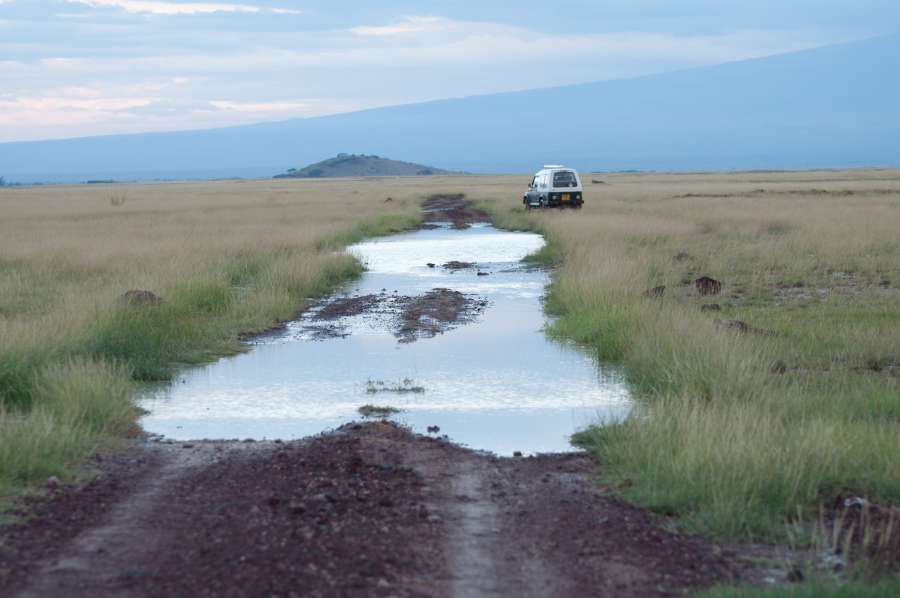
Circumnavigate, if possible. Photo: Jan Riedinger
If that's not possible, determine the risk of not making it across the obstacle and consider turning back.
If you decided that you can and will drive over the obstacle, plan the track that all four wheels will take over the obstacle without getting any of the wheels into a hole or between two big stones. Steep ascends or descends are usually no problem, since the 4WD has extraordinary climbing and braking force with four-wheel drive engaged and in the slowest gear. If you drive down a steep, rough descent, you can do it without using the engine and at extremely slow speed by using the foot brake. This allows a slower speed than uphill, which can be an advantage because it leaves you more time to react and the car is not shaking as much, allowing fine brake dosage.
When going uphill, you need four-wheel drive and the slowest forward gear engaged, clutch fully released and a certain minimal number of engine rpm, at least twice the idling speed, approx. 1,500 rpm, so the engine develops enough torque. If the ascend is not steep, you may be able to move at even lower speeds, just above idling, so all movements remain very slow and well controllable.
Very important: the heel of the accelerator foot has to be firmly on the floor, because otherwise you cannot control the accelerator in a jumping and shaking vehicle.
Mud holes can be a particular challenge. Always try first to circumvent the water completely by driving some distance up the river or to the side. If this is not possible because of other obstacles, then try to drive on the side with one pair of wheels outside the hole, so that you keep the traction and guidance at least on one side. If all this is not possible, then you have only the choice between driving through and turning back.
If the wheels come into contact with mud, you must always activate the four-wheel drive before entering. Here also always select the slowest gear, because you may need force to overcome submerged obstacles.
A safe method, even when driving through deep and long mud holes, would be to gather some speed and use the momentum to drive through, if it weren't for the danger of a large stone or tree trunk submerged in the middle. Try to examine the mud hole with a stick for such obstacles. If you are convinced that no obstacle is there, then you can reverse, accelerate, and drive through the mud with speed.
Stay calm when the mud sprays up and obscures your windshield. The mud can also slosh into open windows, therefore close all windows beforehand and don't panic if you suddenly don't see much.
If you can't test the mud hole beforehand and if it is large, then you have an uncalculable risk to get stuck and be unable to get out by your own means. You can still try to estimate the risk by checking whether the ground in the area is generally stony and by looking at fresh tracks of other cars that crossed it recently, but bigger off-road vehicles or trucks may be able to cross obstacles that a smaller car with smaller wheels may not be able to cross. However, you still don't know which method the other drivers used, where exactly they steered, or whether the bottom is stony or soggy. If you cannot arrive at the conclusion that you can successfully cross the obstacle, you have to turn back and look for another way.
Many 4WD vehicles have an additional shift lever for the four-wheel drive. This lever has three positions:
If one of these positions cannot be engaged, then release the lever, shift the normal gear switch into neutral, release the clutch briefly, then step on it again. If you can still not select the desired position, then set the car in motion slowly in first gear and the steering straight, then switch while the car is slowly rolling. Even this sometimes doesn't work when you drive a curve, because of the high torque forces between left and right wheel with the differential lock engaged. This is the reason why you may have to drive straight forward to shift the four-wheel drive lever.
There are exceptions, however, and so it pays to know your off-road car well. In the Suzuki Maruti Gypsy and the Suzuki Sierra, for example, you can shift from 2 wheel high to 4 wheel high and vice versa while you drive, even at moderate speeds; you only may have to release the accelerator momentarily while pushing on the lever, because otherwise the load on the gear prevents the shift. This is very advantageous when driving along wet tracks, as you can shift in and out of 4-wheel drive as often as you like and in any situation, without having to stop. You cannot switch between 4-wheel high (fast) and 4-wheel low (slow) while moving at speed, however.
If you have a four-wheel drive high/fast and a four-wheel drive low/slow setting, the four-wheel high/fast setting is normally unimportant and of little use, exept in the case described above. So remember that you want the two-wheel high/fast setting for normal driving and the four-wheel low/slow setting for negotiating difficult terrain and obstacles.
Four-wheel drive means that all wheels are propelled (unless you have unlocked the free-wheeling switches on the front wheels, as described in the respective subchapter below). The four-wheel slow setting also means that the speeds are lower by a factor of roughly 2, which is more than the factor between two adjacent gears. The idea is to have the slow speed gears interspersed between the high speed gears. For example, assuming the same engine rpm, the third slow gear would yield a driving speed somewhere between the first and second fast gears. Most off-road vehicles work that way, although there is a tendency in some modern ones for even slower speeds that are particularly suitable for rock crawling.
Being half as fast at the same engine rpm means having twice the force, which becomes dramatically apparent in the first gear when the 4WD is set for slow, four-wheel operation. Even a small 4WD vehicle is now extremely forceful and doesn't need much accelerator to climb even steep slopes and drive over big rocks (the already mentioned rock crawling). Always use this setting, slow four-wheel drive and first gear, when you have to drive slowly over very difficult terrain.
Normally you drive in the two-wheel drive setting, so only the rear wheels are driven. Some 4WD vehicles have free-wheeling switches on the front axles, the older designs being switchable by hand from the outside hubs of the front wheels. You turn a knob from the LOCKED to the FREE position. Thus the axles of the front wheels become uncoupled and do not rotate. This, so the manufacturers of those locks state, saves 2% in fuel.
Assuming that the manufacturers will certainly not understate the importance of their product, this means that you want these locks unlocked, as long as you drive on paved or otherwise very good roads, but you always want them locked before you do any off-road or narrow track driving, like in nature reserves. One of the most stupid mistakes is to forget that your front wheels are free-wheeling and get stuck because your rear wheels dig themselves in.
In other words, it is a rather slight error to have them locked by mistake, but a severe error to have them unlocked by mistake. Keep this in mind.
The locks also allow you to use the lower, more powerful transmission ratio in two-wheel drive. To use this, you have the locks set to freewheeling and the four-wheel drive lever in the four wheel low position. A situation in which this could be useful is when you want to drive extremely slowly or up a steep slope, where you still don't need the four-wheel drive.
Most larger 4WD vehicles additionally have a differential lock. To understand what this means, you first have to understand what a differential is.
It is a small gearbox that has one driveshaft coming in from the main gearbox (or from another, central differential) and to outgoing driveshafts, usually the axles going to the wheels (or the driveshafts going to the rear and front axles).
The purpose of the differential is to allow one wheel (or one axle) to rotate faster or slower than the other while still forwarding the rotational force to both. This is necessary in curves and to a smaller extent even going straight, because of a slightly differing wheel radius. Without differentials there would be constant high forces, leading to some wasted energy and a lot of wear and tear.
A 4WD can have up to three differentials. One near the main gearbox, dividing the rotational force onto two driveshafts, one leading to the rear axle, one to the front.
Then there are two in about the middle of each axle, dividing the force onto the two wheel axles. Some smaller, less expensive 4WDs (like the Suzuki Maruti Gypsy and the Suzuki Sierra) do not have a center differential and instead convey the rotation equally to the front and the rear axles. In such cars you should engage the four-wheel drive only briefly when you really need it, or only on ground with little traction, like sandy or wet soil, because otherwise you will cause excessive wear and tear and even steering will become difficult.
The classic differential distributes exactly the same force to both output axles. This, however, has one disadvantage. If one of the two wheels (or axles) has no resistance, for example because one wheel is on slippery ground or hanging in the air, the other wheel also does not receive any driving force. What will happen is that the slipping wheel will rotate at twice the speed, while the other one, that is on the ground, will stand still and not convey any significant force at all.
On good roads this never happens, but out in the bush it does. Therefore most bigger, more expensive 4WD vehicles have differential locks, some for all three differentials, some only for the front and rear axle differentials. Smaller, cheaper off-roaders (again like the Suzuki Maruti Gypsy and the Suzuki Sierra) do not have any differential locks at all, meaning that you should avoid situations in which two diagonally opposed wheels lose ground traction.
On those 4WDs that have differential locks, the differentials can be locked by means of a special lever or button. You engage the differential lock before one or two wheels are slipping or hanging in the air. As soon as the car is moving on firm ground again, you should immediately disengage the differential lock to avoid the high axle forces and the accompanying wear and tear. In most cars the differential locks can be engaged and disengaged while driving at any speed.
The most freqent beginner error when driving a 4WD off-road vehicle is to drive over obstacles with slipping clutch. Nearly everybody does this, because in the limousines back home the first gear is usually to long (too fast) to drive very slowly with the clutch fully engaged, i.e. the pedal fully released.
Unlearn this and never do it again. Why?
For these reasons there is one rule: letting the clutch slip is only appropriate when you stand and begin to move. As soon as the car rolls with sufficient speed, the clutch should be fully released. After shifting gears the clutch is immediately, fairly quickly, and fully released. The only two exceptions are that you either have to drive too slowly for the first gear for a short distance, for example in a traffic jam or for parking, and don't want to engage the slow off-road gears, or that you're rolling slowly downhill and don't need the engine.
Actually the same rules apply to driving your limousine back home, but some drivers have developed bad habits, because in the limousine it does not matter much.
The other point is that the heel of the clutch foot has to be firmly on the floor when you start driving. On a smooth, paved road this hardly matters, but when you want to move the off-road car out of a more difficult situation, the clutch is often uncontrollable or not controllable finely enough when the clutch foot hovers above the floor.
A typical situation is that the off-road vehicle has stopped with the wheel locked between two stones. To set it moving again, you have to use a lot of accelerator and a lot of power while the clutch is slipping, until the vehicle suddenly begins to rise above the blocking stone and shoots forward. If your clutch foot heel were not firmly on the floor, your clutch foot would be pulled back along with your entire body by the sudden acceleration, releasing the clutch fully and leading to an uncontrollable jump forward of the entire vehicle. You don't want that, so always remember to have the heel of the clutch foot on the ground. The same holds for the accelerator foot, as already mentioned earlier.
The general rule is that you want to keep engine RPM (Rotations Per Minute, the engine speed) at the most cost-efficient value while you drive the desired speed. The problem is to determine what the most cost-efficient value is in the varying circumstances. Let us look at the different problems and their solutions.
If your engine RPM is too high, i.e. you're driving in a too low gear, you entail a few disadvantages. The fuel consumption is higher, wear and tear on engine and gearbox is somewhat higher, and the car is noisy. There is also an advantage though. You can suddenly deliver a lot more force to the wheels, because you don't need any extra time to shift gears first. So in a situation where you may suddenly need a lot of force, it is correct to stay in a lower gear and have the engine revved up. An example is driving through sand or mud or over rocks, where an unexpected obstacle could bring you to a sudden halt if you don't have enough force available.
If your engine RPM is too low, i.e. you're driving in a too high gear, you have some more severe disadvantages. Fuel consumption is usually lower at lower RPM, but if the RPM is very low, it can actually be higher. But a more important reason is that you can cause so much wear and tear on the engine and particularly on the gearbox and all other driveshafts and axles that too low RPM is not advisable under any circumstances.
When is the engine RPM too low? Depending on their size and the number of cylinders, most modern engines can endure full power (accelerator pushed to the stop) from about 1,500 upward for a big engine with six or more cylinders or from about 2,500 rpm up for a very small (1 liter) four cylinder engine.
You can test this for your off-roader by driving it on a smooth, paved road, decelerating to a low speed, like 40 km/h in the highest gear, then pushing the accelerator to the floor and listening to the sound, particularly of the gearbox and axles. Any uncommon vibration and particularly any rattling or otherwise uncommon sound indicates that the RPM is too low.
On the other hand, when you need very little power, i.e. you're not driving uphill, you're driving over smooth ground, and you're not driving very fast, most engines, particularly bigger ones, can deliver enough power even at idling speed. Smaller engines may need a little more rpm, somewhere between 1,000 and 1,500, to deliver power smoothly and without any undue vibrations or rattling. For example, in many (but not all) off-road vehicles, even in small ones, you can drive as slow as 20 km/h in third gear and enjoy very smooth, quiet going, for example on game drives.
Of course the smaller off-roaders with smaller, weaker engines develop only very little power at low RPM, so your scope of driving with low RPM is smaller than with a big engine.
A practical example is this. Some smaller off-road vehicles, for example the Suzuki ones, particularly the Sierra and to a lesser extent the Gypsy, if it is no longer new, create a rattling noise in their transmissions when you use low engine speeds with high torque (accelerator pushed far down). This disappears when you reduce the power (release the accelerator partly). Needless to say, the speeds and power settings at which this rattling occurs have to be avoided reliably. So you have to test the off-road car on a smooth road and, not having an RPM indicator, remember the speeds at which this happens.
The following table shows an example for the lowest tachometer speeds in km/h that you should not undercut for a small off-roader like the Suzuki Maruti Gypsy. Take these only as a very raw guidance, because every type of vehicle is different in this respect. The speeds are indicated tachometer speeds, not true speeds. The true speeds are usually lower, depending on tire diameter.
| Gear | Very Low Power | Medium Power | High Power |
|---|---|---|---|
| 1 | N/A | N/A | N/A |
| 2 | N/A | 15 | 20 |
| 3 | 20 | 30 | 40 |
| 4 | 40 | 50 | 60 |
| 5 | N/A | 60 | 70 |
Minimum speeds for the Suzuki Maruti Gypsy
The N/A entries are there because the precise lowest speeds for these gears are not known and play hardly any role, because for example in first gear you accelerate so quickly that you usually reach a sufficient speed anyway before full power is applied. The N/A for the 5th gear is there because you cannot drive in 5th gear with very low power, except downhill.
The very low power speeds apply when you go horizontally on a very smooth road, like a paved road (or when you go downhill).
Larger off-roaders, like an Isuzu Trooper, can be driven at amazingly low RPM values at or near idling speed, as long as the road is smooth and horizontal (or downhill). This is particularly pleasant on game drives, because the car is then very quiet and comfortable.
But note that the 3rd gear of the Suzuki Maruti Gypsy is ideal for game drives. Many drivers make the mistake of staying in 2nd gear while driving 20 km/h and above during game drives, where you actually want to have the engine as quiet as possible.
If, however, you encounter an obstacle or if the path slopes upward, you have to shift into a lower gear before reaching the obstacle or slope.
On long journeys without fuel stations or if you're short of fuel, you may want to drive in the most fuel-efficient way, if possible. The highest range is always achieved in the highest gear, so the question is whether you can keep up the minimal speed required to drive in that gear. For example, the longest possible range is probably achieved in a Suzuki Maruti Gypsy when driving at around 60 in fifth gear at quite a bit less than full power.
Of course you cannot keep this up when the road goes uphill or when the surface or curves don't allow this speed. The first advice here is not to get short of fuel in the first place, so there is no question of wanting to drive faster for that reason in the first place. Never let fuel calculations tempt you into taking additional risks. When you drive into a curve where you cannot see any possible oposing traffic or any obstacle, of course you have to reduce speed and shift into a lower gear no matter what. An accident is even worse than getting stuck because your tank is empty.
A particular problem on the sidelines is dust avoidance. When you drive through a dry, dusty area, there is an unpleasant tendency of the dust to get into the car and accumulate there. This is difficult to avoid entirely, but there are a few ways to reduce the amount of dust.
First of all we have to understand how and why dust gets into the car. Obviously, some dust will come in with the air you use for ventilation, unless you have an off-road vehicle with an air filter (and air conditioning), which is not a frequent occurrence exactly in those countries where it would be needed most. Some dust then sticks to every surface and usually stays there.
But this doesn't explain the high amounts of dust one is often gathering inside the car. The unpleasant truth is that it is a physical law that makes the situation in a moving vehicle worse. This law was found by the physicist Daniel Bernoulli, is known as Bernoulli's equation, and postulates that the pressure decreases as a gas (or a liquid) streams by an object.
The problem occurs mainly when you drive with open windows, which you often have to because of the heat. Dust is stirred up by the wheels, particularly by air being pushed aside in front of the wheel and air being sucked under the wheel behind it and turbulently streaming around the wheel. Due to the turbulent air flows under the off-road car and to the side of the wheels, the lower rear of the car is often moving in a dense cloud of dust.
Even though this dust usually does not reach the open windows (unless you suddenly stop), it seeps in through all small gaps, even under the driver's door and even more around the rear part of the car.
This happens because Bernoulli's effect of the air streaming past the open windows creates a lower air pressure inside the car, not exactly a vacuum, but enough to suck in dust through all holes and gaps.
Knowing this, what can we do about it? One simple way is to drive very slowly, something between pedestrian and bicycle speed. This is OK for the occasional dust bowl, but usually you don't have the time to go so slow for long. The other way is to close all windows and switch on the electric ventilation. Depending on the car you may need more or less forceful ventilation to counteract the Bernoulli effect, which is still working on the main vents and small gaps and holes and might still suck some dust through some holes if you wouldn't create a slightly higher pressure inside with the ventilation.
Of course this depends very much on the design of the car and its ventilation system, and in a warm climate it may get too hot in the car, but that's about all we can do about the dust getting into the car.
A very simple method to keep at least the luggage clean is to put travelling bags into a seabag or a huge plastic bag or into one large enough plastic bag each. This is one of the reasons to have a seabag with you. (The other is that you may encounter the two-pieces-of-luggage airline rule that may force you to put several bags into a big one to stay within the two pieces limit.)
Another, not so heavy source of dust is oncoming traffic in combination with a wind direction that blows the dust wake over to your side of the road. Fortunately this problem is not continuous, but occurs only when you meet another car.
The standard method of dealing with such dust wakes is to crank up all windows and stop all ventilation blowing air into the car. In some cars you can set the ventilation to circular air flow, rather than fresh air flow through. In others all you can do is to switch the ventilation off and hope that your car actually blocks the residual air flow. Some cars do that, others don't and keep some air flowing through. The only other thing you can do is reduce the speed until the other car has passed, which is also a display of politeness, because you stir up less dust yourself and your tires also won't throw stones as much.
By the way, stones thrown up by the tires can hit the windshield of oncoming cars and actually shatter them. Other than driving more slowly to reduce the problem a little, what you can do is put your flat hand near the middle of the windshield (or one hand of the driver and a passenger in the middle of each pane if there are two) and press your hand against it. This dampens the high-frequency vibrations caused by a stone hitting the glass and can often avoid the shattering of the glass.
Another method to avoid these dust wakes is to drive over to the wrong side of the road and off the road, then stop and let the other traffic pass. Since you're doing a rather irritating move to the wrong side of the road, you have to do it in time, so the other driver does not get confused and doesn't try to avoid you by also swerving to that side. You want to be stopped off the road much earlier than the other car passes, 10 seconds at the very least.
This maneuver looks stupid and wastes a lot of time if you do it often, but it may still be sensible when the dust wakes are very thick and when there are not too many other cars around. It also borders on an illegal road maneuver, so apply it sensibly and with caution.
All in all a 4WD off-road vehicle is a fascinating means of transport. After you will have driven the first thousand kilometers in one, you will most likely appreciate the advantages of such a powerful rough-terrain vehicle.
The Global Positioning System is a fascinating, new technology for finding out where exactly your are. The system of approx. 28 satellites, equipped with atomic clocks and circling the earth at a distance of 20,000 km and moving at 8,000 km/h, operated by the American military, makes it possible to determine position and height to a few meters with a smartphone or another GPS receiver.
The most suitable device is a smartphone, such as an Android phone or an iPhone. Also bring a car cigarette lighter charger and a ventilation grille holder. Suction cup holders for the windshield are problematic and less suited to the task.
Do not forget the holder! You cannot leave the device banging around in the car, you cannot stow it away because it does not receive well in any other place than on the dashboard under the windshield, and no passenger will be willing to hold it up for something like a 10 hour drive.
Before you travel, make sure that the charger charges more than the 500 mA you get from a computer USB port. You may need a different cable for that, like one of the portapow charge-only cables, available through Amazon. Most smartphones follow the EPS standard and pull the full charging current only when the two data lines (2 and 3 in most USB plugs) are shorted.
If your smartphone can use Google Maps, go to michna.com/gps, go to the Nature Reserve Mapping Project, and follow the procedure for smartphones. In Google Maps use the function "Make available offline" to load critical areas beforehand, particularly along the Baringo – Samburu route, which has only spotty mobile phone coverage.
If you like to record your tracks, install Google's My Tracks on your phone.
If you are interested in mapping software, you can install Locus Map Free, which can replace both Google Maps and My Tracks and work offline. But this is a complex piece of software that requires learning. Contact me in time before you go that way.
It would be very unwise not to use this simple and inexpensive navigation technology, because without it you could lose your way and, in the very worst case, your life.
However, the GPS receiver does not replace the map, which you must also have with you in any case. A small compass also belongs to the complete equipment. You will need it if the GPS receiver fails or gets lost.
Begin in time before travelling to transfer the waypoints and routes, which you can download from michna.com/gps, into the app or the GPS device and test the function. You may need a suitable data cable.
Depending on the kind of dashboard holder you may want to have a piece of foam rubber with you that you can position under the holder to prevent some of the shaking.
If possible, you should always drive in a convoy; only if all passengers in one car agree on driving on their own, you can take a different route, but it would be on your own risk (not recommended). Driving in a convoy increases safety substantially. On dusty tracks the distance between the cars must be increased, depending on the wind up to several kilometers. However the visual contact should not be interrupted continuously. Look regularly into the rear-viewing mirror. If you cannot see the following car any more, stop and wait for it. If it does not appear during the next minute, turn around immediately and drive back. The best you can find back there is the other car standing in front of a pride of lions or another photo motive, which you did not see because you were driving to fast. (This happens a lot).
In case you have several route suggestions, you have to take the easiest route.
You should always drive at a comfortable speed, which is much slower than the possible maximum. There are two reasons for this:
On top of that, the range is higher at low speeds, as long as you can drive in the highest gear(starting from approx. 40 km/h).
I urge you to follow these few rules, and I speak from many years of experience. Unfortunately, some male travelers have a tendency to try to stand out through special initiatives or fast driving. However, a journey like this always suffers if male travelers are constantly busying themselves with direct or indirect ranking fights or with proving themselves as racing drivers. Moreover, this lowers the general safety, also for the other cars. Besides that you should always be aware of the fact that all passengers of the car have to rely on each other. For special initiatives there are three possibilities:
If you encounter wild animals, the first rule is that the animals are not to be disturbed. It is e.g. absolutely illegal to throw a stone at an animal in order to force it into a better position for a picture. Also do not drive close to an animal if it reacts to the car. In other words, as soon as an animal shows any further reaction but quietly looking at the car, you should stop immediately.
The exception are animals that block the way. Wait first to see whether they move away. If they don't, drive on very slowly to give them time to move without wasting their energy unnecessarily.
Special caution is required with animals that are able to defend themselves and that are unpredictable such as hippo, buffalo, rhinoceros (if we should have the luck, to see one), elephant, and lion, because they attack. You should also be careful with shy animals, like leopards, cheetahs, birds of prey, because they flee. The best sign for the fact that an animal does not feel in trouble, is that it continues feeding and does not look at you. If it stops feeding, then you should stop moving. Signs of irritation are for the hippo to stop feeding and freeze, for all other of the above five species to shake the head, to snort, and similar signals. Most of these five species can attack suddenly, with little warning.
If buffalos block the way and if it is not possible to drive around them, then you have to drive close until they recognize you and look at you. Now you need patience and have to wait until the animals themselves lose patience and move out of the way. They normally do that, but it can take 10 minutes or longer. The normal behavior of the buffalo is not to run away if there is any danger, but to attack if necessary. Therefore it is much more difficult to handle a herd of buffalos than other animals.
When you observe a cheetah, you should additionally pay attention not to obstruct their hunt, because they are diurnal (day-active), unlike the other big cats. Do not place yourself in such a way behind the cheetah that potential prey is alerted to the cat by the car. The best position is probably at the side, perhaps even closer to the potential prey than to the cheetah. The most important thing in such a situation is not to drive to close at all, but rather to observe and predict, how the situation is developing.
If you do not like car rides, you have the opportunity to fly by light airplane. We will usually have at least one light plane that fits four people (e.g. a Cessna 182, 1 engine with 235 HP, more than 2,000 km max. range).
For an impression of what it can be like, you can watch this video, but only if you have a fast Internet connection.
Flying is more expensive though, and it is not possible for everybody at the same time on all journeys. A to-and-fro shuttle flight, for example on the route Baringo – Maralal – Samburu, can normally only be flown with an intermediate refuelling stop in Nanyuki or Nairobi, because there is no other place in the area, where you can refuel, unless a car would carry extra fuel for the plane. Of course the detour to Nairobi increases the price.
On the route to the coast one can refuel in Mombasa and Malindi, so that this problem does not occur there. I always have to make shuttle flights though, which must be paid completely, and one hour of flying costs approx. €150, which has to be shared by all passengers. I am definitely willing to make such flights, which also help to achieve the minimum flying time per day, which we must pay with this rented airplane. Up to three passengers with very light luggage can fly in one plane.
The atmosphere in Kenya is usually choppy because of earth surface heating by the sun, so that the airplane usually constantly rocks. Who cannot stand this, should not fly. Otherwise flying is of course very pleasant. The temperatures up in the air are lower. Only the engine and propeller make a substantial noise. I have a supply of foam rubber ear plugs, which absorb the noise and leave only a dull humming. Flying is also safer than driving a car.
There is also the safety aspect of the plane that it allows to fly a sick person back to Nairobi quickly, should that ever happen. (This has happened to me once, when a friend, himself a pilot, had a kidney colic.)
In the improbable case of a forced landing you should observe the following rules.
Who carries a small tent and is therefore independent of the lodges, can save money and has the unforgettable experience of the tropical night.
I once slept in my tent with the flap open, but the mosquito screen closed. I enjoyed the view of the stars, but soon afterwards I realized that this may have been stupid, as lions frequently come close to tents, and it is not clear whether a lion can become dangerous when confronted with a visible sleeping human at such a close distance. I've never done this again in any small tent and always closed the outer tent. I do keep the flaps open and rely only on the insect screens in bigger tents though, where I do not sleep so close to the screens.
Normally lions never attack closed tents, but if you really invite them …
Tents are safe, because animals behave reasonably and represent no danger. One should, however, observe a few rules.
If animals come close to your tent, keep quiet at first and try to determine whether they are herbivores. If you hear them tearing grass, they are no immediate danger for you as long as you don't scare the biggest ones, like buffalos or hippos, rhinos or elephants.
Elephants are a special case, because you can rely on their knowledge about you if they are close enough, because of their extremely good senses of smell and hearing and their intelligence. In fact I regard them as friendly (unless there's a spoilt elephant bull who is used to looking for human food, which is rare on camp sites and should be known in advance).
If predators (usually lions or hyaenas—you rarely hear leopards) come within inches of the tent, sniff on it and don't go away again quickly, you can shout at them to scare them away if you feel like it. Otherwise keep quiet. If an animal actually touches the tent, you should immediately shout at it.
If you really decide to flee from a nearby animal into the car, first irritate the animal with a flashlight and be quick. Even a lion will not normally attack in such an unusual situation, unless he is very close (a few meters) and feels directly threatened. Always keep a dangerous animal in sight. In case of doubt throw some clothing or anything else after the animal. It will have to deal with the object first, and then with you. If the animal shows aggression, throw stones, clubs or other things at it, in order to demonstrate that you will not give up without a fight and that you can fight even from a distance, which the animal himself cannot do and which will confuse him.
If a more critical situation develops, usually because a human makes some mistake, use the following hints.
One special case should be mentioned. When you walk in the bush and suddenly notice a predator (lion, leopard) lying in hiding nearby, control yourself, immediately look away and do not look at the animal again, particularly avoid eye contact, and pretend not to have seen it. Continue to walk past the animal without getting closer. If it's a lion, look out carefully for more lions nearby.
The explanation is that the predator has to make a decision to either rise and move away or staying put. Rising incurs a high risk of detection, thus the predator will often stay in hiding, hoping not to be spotted.
If you suddenly stare at the animal, revealing that you have seen it, and if you're within the critical distance of a few meters, the animal may preemptively attack you, which leads to serious injury or death of the person being attacked.
These recommendations originate from advice by experienced wildlife researchers, from limited own experience and from thinking a lot about the topic. In spite of spending years in Africa myself and camping out in the bush many times, I have never experienced any of these conflict scenarios with predators. When I once walked straight towards a pride of lions without noticing them in time, they rose and went out of my way. Herbivores warn and threaten when you come too close and they recognize you as human, with the exception of the hippo, which freezes when you walk towards it and suddenly attacks at a distance of a few meters. Of course you should never walk around in the bush at night.
Fires do not help. They attract curious animals. On the other hand, they don't do any harm either, so, if there is no risk of a bush fire, do light up a campfire and enjoy the tropical evening. Pay attention not to bury beverages or food remains in the proximity of the tent, not even small quantities, because the smell would again attract animals. Either eat and drink very carefully or in the car or at some distance from the tent, so even if the residual smell attracts animals, they don't get the idea that you have food in the tent. For this reason you should choose your resting place or your fireplace a couple of meters away from the tent. Pay attention to your environment and look around regularly. Do not make noise, so that you can also hear your environment.
The lion prides, in or between whose territories you are, can usually be heard at night, since they give off a signal call approximately every 20 minutes. There is no guarantee, however, that you will always be forewarned when lions approach, as there are also wandering lions who keep quiet when they trespass. Also hyaenas are often audible, since they coordinate their nocturnal hunt by calls. Some hyaenas and other night predators such as leopards are, however, inaudible, therefore it cannot hurt to regularly have a look around the campfire. Pay attention also to the conspicuous alarm calls of other animals, such as apes and birds, and use a flashlight to find out who comes visit.
With small children I would not recommend to camp, because predators have a special interest in young animals and because small children behave can behave inappropriately in critical situations. I do not have any experience with camping with small children in Africa, because I never dared to do it.
On request Rasul's Car Hire will gladly remove the rear seat from the Suzuki and give you a sleep mattress instead. This works quite well for one person and could be suitable for up to two small children, one with the head forward, the other with the head towards the rear. It is not sufficient, however, for two adults. In the car you are completely safe from wild animals and can therefore sleep better than in the tent.
After two or three nights in the tent it is a good idea to insert one night in a lodge, mainly because of the possibly limited night rest out in the bush and for hygienic reasons. From time to time one may want to sleep long and take a shower, for which the lodges are best suited. Note that you can have lunch in a lodge even if you do not spend the night there, though the price may be a bit on the high side.
If you want to use electronic equipment, you need a few additional devices.
Since an inverter often gets hot and therefore has a considerable energy loss, it is recommended to use it only for the shortest possible time and recharge all devices at the same time. If you leave an inverter connected overnight, you risk a dead battery.
You definitely need a good telephoto lens for wildlife photography. My experience is that 200 mm (all numbers given here are 35 mm film equivalent) are not sufficient. When I changed to a good 300 mm telezoom, I perceived the upgrade from 200 to 300 mm focal length as a relief for photographing animals. Less than 200 mm are frustrating, but of course still better than nothing at all. Lenses with focal lengths of 400 mm and more are theoretically even better, but they used to be too large, too heavy, therefore increasingly difficult to handle, and also very expensive. IS (image Stabilizer) lenses are very suitable and recommended, because they can compensate for movements of the car caused by the passengers. But today, in the age of digital photography, things have become much easier.
In fact, there are some cameras with image stabilized 420 mm (equivalent) focal length zoom lenses made by Leica, that are recommendable for amateur wildlife photography, namely the Panasonic Lumix DMC-FZ5, -FZ15, -FZ20 range of cameras. I have been and am still using the predecessor of the FZ5 with good success (see the travel reports since 2003 for samples). More such cameras will surely appear over the next years, so wildlife photography has never been easier. A word of caution, however: at a focal length of 420 mm even the best image stabilizer can still not compensate for the shaking of photography from the free hand. You have to at least lean the camera against something, like the car window frame.
Since in my experience almost all participants take photos, the driver should stop immediately when asked by any one passenger and, if desired, reverse and move back into the best position, in order to make the best photo possible. Experience shows that inexperienced photographers are typically inclined to excuse missed photo opportunities with the following rationalizations:
In truth almost every situation is absolutely unique.
In truth the others then mostly take a photo as well. In addition, a good photo is always worth a little effort.
In truth one can often detect a photogenic situation while driving past. Usually one must then back up some meters to find that spotted situation again exactly. The human brain has some amazing abilities here. If one has the sudden impression that a special photo situation was seen, then that is not always, but often true. Sometimes stopping and going back will yield further improvements, further photos, or unexpected photographic design possibilities.
It cannot always be taken for granted that one may photograph people. Many Kenyans, affected by tourism, learned that one can ask for cash in return for photos, and some have the idea that you could be the stupid tourist who will pay them a fortune for a photo. Then prices of several hundred shillings are demanded, which is way outside normal incomes in Kenya.
In cities you can easily ask for permission to take a photo of people. Do it quickly and don't hesitate after the question. Have the camera ready beforehand, take the photo on the spot, and immediately take the camera down before anybody gets the idea to demand money. In many cases you can give the impression that you haven't actually taken a photo, because the people often don't exactly understand the technical process and are not accustomed to rapid photographing, because most tourists are unable to do this.
Articulated (swivelling) viewfinders are very helpful, because with them you can take photos without anybody noticing.
There should be no need to explain that all beeps and clicks and other sounds of the camera should be totally switched off.
If you photograph sitting humans, e.g. on markets, then a wide angle lens helps. Thus you can photograph e.g. a desk with goods and at the same time all people, who sit around the table, without them being aware of being photographed. Additionally this has the advantage that they look interested and don't gaze into the camera with a petrified face.
Do take portrait photos. There are very many beautiful and interesting looking people in Kenya.
Do not always try to fit everything into one photo. If you have a telezoom lens, use the enlargement, for example for portrait photos. Understand that tele photos can very easily be blurred. Put the camera on something or lean it against something to hold it still, if at all possible, or use the flash, if the object is close enough and if this type of lighting is not detrimental to the picture.
Know also the range of your flash and do not try, as many beginners senselessly do, to use the flash to take a photo of something that's 20 m away. Even strong flash devices, depending on circumstances, usually reach only 5 to 10 m. Small, built-in flashes rarely reach farther than 3 m.
The biggest, and quite considerable, health risk is malaria. It is transferred by the anopheles mosquito, a small mosquito that can be recognized by the fact that its trunk sticks out horizontally when the mosquito sits on a surface, rather than diagonally downward from the body, as we know it from the mosquitos back home. It must therefore move its abdomen upward when stinging, since it cannot bend the trunk down far enough.
Malaria can be incurable and deadly. One frequent error in non-malarial countries is to do a diagnosis first and wait for its results when a returning tourist shows malaria-like symptoms. Physicians in malaria countries know this trap and treat for malaria without waiting for a diagnosis or without even attempting one, because the results of a diagnosis, even if one were possible, could come too late. Travelers have died after their return to Europe, because the physicians do not follow this way of thinking or because the patient didn't tell that he had been in the tropics.
The Anopheles flies and stings most often late in the night, towards the morning, when people normally sleep, but it can sting at any time during the evening and night. Our means of defense are:
The mosquito net must always be applied conscientiously. If your net has not been impregnated already with Perethrin, then you can do this before first use. Mosquito nets can be bought in Nairobi (not on weekends, however, when the shops are closed). They can also be bought at home from mail order shops or specialist expedition shops.
For a couple a large double bed net can be romantic, however, it works only for double beds, therefore you still need an additional normal one, thus two nets.
You also need a handful of wood screw hooks and a long string, in order to be able to attach the net in various accommodations. Take several screw hooks with you, so that you do not have to unscrew them again, but can simply leave them there (perhaps for the next journey or for the next guest).
If you stay overnight only in better tourist lodges or in the tent, then you do not necessarily need your own mosquito net, because almost all lodges already have nets or window fly screens installed. You should, however, carry some sticky tape to repair holes in the net. And you should spray each net once before the first use with an insect poison for textiles. Don't do this just before going to bed. Better do it already in the afternoon or when you arrive and air the room afterwards.
The anti-malaria drug Lariam shows a wide variety of unpleasant side effects in some humans, such as hallucinations, sleep disturbances etc. If you observe such effects after beginning to take it, then you should switch to a different drug, e.g. Malarone. Many people can tolerate Lariam well, however, and it is an effective means against malaria. The newer drug Malarone has fewer side effects with good effectiveness, especially against malaria tropica (caused by plasmodium falciparum) and is therefore recommended. It is, however, much more expensive. Malarone can also be used as a highly effective cure for plasmodium falciparum.
It may be less effective against malaria tertiana (caused by plasmodium vivax), the recurring malaria that is, fortunately, by far not as quick and deadly as malaria tropica. This means that you should visit a doctor immediately if you have symptoms, to get an effective cure against the specific kind of malaria you may have, even after you have taken a Malarone cure dose.
The MalaQuick malaria self check is now easily available. A package contains two tests and is sufficient for a vacation. This test can prevent taking the cure dosis unnecessarily. It is very sensitive, but can have up to 4% false positives, so be prepared to take a malaria cure dosis when the test is positive. (If you don't, then it makes no sense to take the test in the first place.)
Read the test instructions carefully before you apply the test. Don't take too much blood for one test. Do not fill the capillary entirely and do not use more than one filling. Hold the capillary horizontally, so it gets filled with blood easily.
In a small group one package of MalaQuick can be shared, because it is unlikely that everybody needs two tests. In a larger group, take two packages, i.e. 4 tests.
Two further enemies help the dangerous mosquito, according to experience:
In very dry areas and high on the mountains there are no mosquitos. In uninhabited areas they do not carry malaria. But in each lodge there are potential malaria carriers: the employees. From them you can get the disease through mosquitos.
AIDS is very common in Africa, particularly in east Africa. Avoid sexual contact, blood transfusions and injections, unless you personally observed that a one-way needle is used that was taken from the closed package. Remember that you must make these decisions rapidly and determinedly.
There are some experts who state that a reliable AIDS test under the practical conditions prevailing in Africa is not feasible. If this is correct, then every blood transfusion is dangerous. This also means that you should be even more careful when driving a car and carefully avoid all accident risks, so you don't get into a situation where you have to receive a blood transfusion at all.
The occasional light diarrhea is almost guaranteed in Kenya. One reason is the heat diarrhea already mentioned, but one can make things worse by careless eating. Immodium, Metifex, or similar drugs against travelling sickness can help in some cases, but they won't help with any severe infection.
You have to consider three phenomena in Africa.
And here are my recommendations, if you find that you are susceptible.
All of these hints are not scientifically proven. I invented them. They work for me and for some others. They don't work for everyone. People who are used to drinking a lot anyway may not need most of them. They may be wrong. But they may be helpful.
A small additional danger occurs when the skin is cut. In our cool homeland climate skin lesions are usually unproblematic. In Africa, however, with higher temperatures and the attendant sweat, dust, dirt, insects and microbes ulcers can form, like the tropical ulcer, if even small wounds are not treated carefully. It is advisable first of all to avoid skin lesions altogether, e.g. by being careful and putting on long trousers, and secondly, to keep wounds clean and put a plaster on them.
Snakes, scorpions, spiders, and poisonous insects constitute another hazard. However, snake bites are very uncommon with tourists, and snakes are only rarely seen. When you walk in the bush, tread heavily and avoid stalking where possible. Snakes are shy and will either move away or warn you when they hear you or feel you coming through vibrations of the ground.
Most scorpion stings are probably incurred when grabbing firewood and inadvertently reaching for a scorpion hiding in the wood. Another cause of scorpion bites is that a scorpion goes into your shoes and you don't check them before you use them in the morning. Scorpions, spiders, and other insects can also hide in and under beds, in cabinets, or in gaps on the floor.
Be aware of ticks. When you look at the grass more closely, you will quickly notice that they are everywhere, sitting at the tip of grass straws waiting for you to pass by.
Adult ticks and pepper ticks
Pepper ticks, which are the larvae or nymphs of the bigger ticks, can be unpleasant, because you can barely see them at their size of less than 1 mm. So be careful and inspect your clothes and legs after you've walked through the grass. It helps if your clothes are of a color different from that of the ticks.
A simple countermeasure is to fold your trouser legs close to your leg, then pull the socks over the trousers, so the ticks can't get at your legs at all. You may still get the occasional tick that somehow entered your clothes in other ways, but this risk is very much smaller. In addition, it helps a lot to spray some strong, poisonous insect repellant onto your socks and the lower parts of your trousers.
For more information on ticks please see this WHO page.
Further health information can be found on the Web site of the Tropical Insititute of Antwerp.
Information on bloodsucking insects and arthropods can be found on this WHO web site on vector control.
The largest safety risk may well be the traffic accident. Therefore always drive extremely defensively, because you do not know the sometimes strange and dangerous customs of the country yet. For example, when overtaking in front of a hill top in Kenya, it is not common to think about whether perhaps some still invisible oncoming traffic could actually exist.
A special risk for pedestrian tourists in Kenya is to look only to the left before crossing a road. In Kenya cars come from the right, because of the left hand traffic. An acquaintance died after being unconscious for four days after a severe head injury, because he looked to the left, then proceeded onto the road and was hit by a motorcycle coming from the right. Take this danger seriously!
Against the risk of a car breakdown or running out of petrol it helps to fill up at each opportunity, carry the essential tools (car jack, wheel cross, tow rope, ideally two spare wheels) and driving in a convoy when the group travels in more than one car. If not, then you can try to follow another auto tactfully if you can find one that does not drive too fast.
Crime has kept increasing in Kenya with increasing population density. Do not leave a car unguarded in the larger cities. If you park your car, entrust it to the next guard. When you return, give him 50 shillings. This is what the locals do.
There are armed robberies on tourists, in particular in and around Naurobi and Mombasa and on other tourist routes. For example, there are a few robberies every year along the northern route Baringo – Samburu and in the Isiolo area which you have to pass anyway when driving to or from Samburu. We travel nonetheless, because we assume that the risk of a robbery, compared with all other risks (e.g. a traffic accident in Kenya or in Germany), is bearable, and we accept this risk consciously.
Of course nobody can guarantee that we will not be attacked! Each traveller should decide therefore whether he is ready to carry all risks of such a journey.
Assault (and theft) can also come directly or indirectly from state employees (rangers, police) or employees of the lodges, because these are in the best position for it, provided they can hide thier identity. Please have a look at the article Theft in Kenya for more details.
From assaults and its consequences one can protect oneself somewhat, by taking these precautions:
Special hints for driving in larger cities:
Please read the foreign office announcements mentioned in the section Links at the end of this document.
|
Crime in Kenya Nairobbery Lawlessness grips the Kenyan capital
S THE car slowed to a halt, two hands slipped through the open window and held fat balls of fresh excrement, menacingly, before your correspondent's nose. Two street boys, resting their glue-bottles on the window-frame, demanded a shilling (less than two American cents). Your correspondent escaped unsmeared, but several of his neighbours have been less fortunate. Nairobi has grown so lawless that this sort of thing is now common. 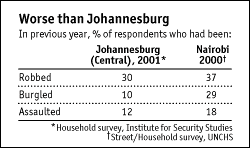
Kenya is a stable country, and its capital, with its sparkling skyscrapers and herds of Land Cruisers, is one of Africa's richest cities. And yet three-quarters of Nairobi's people say they feel unsafe in their homes at night. Reported crime figures are unreliable, but a UN-financed survey last year suggested that the city's residents are more likely to be robbed or assaulted than people who live in central Johannesburg (see table). Of more than 10,000 people surveyed, 37% had been mugged in the previous year. Two-thirds of muggings involved violence, and 40% of victims were injured. Burglaries were even more frightening. Whereas, in most countries, burglars prefer the owners of the houses they rob to be elsewhere, Nairobi's burglars tend to burst in while their victims are at home. Almost a third of respondents had been burgled in the previous year, typically by a gang of five or more thugs waving axes. Car-jackings, too, were much more violent than in, say, South Africa. In two-thirds of cases, the victims were taken hostage, and one female victim in ten was raped. What ails Nairobbery, as the locals call it? Doubtless the city's impoverished millions envy the conspicuously prosperous few. It probably does not help, either, that cheap guns are smuggled in from Somalia, Kenya's chaotic neighbour. But the main reason criminals have grown so bold is that the police are incompetent. They lack vehicles, computers and detective skills. In the slums where most of Nairobi's people live they are invisible, yet there are always clusters of uniforms protecting the Big Men of the ruling party. Ordinary people rarely give them tip-offs because they fear and distrust them. Last year, 90% of those shot dead in Kenya were shot by the police. Recent assassinations of senior police officers, far from evoking sympathy, have convinced many Kenyans that their supposed guardians are entwined with organised crime. A recent survey found that more Kenyans had been ordered to pay bribes by the police than by any other organisation. The top police spokesman dismissed the finding as "one-sided". He said he hated corruption, but added: "What do you expect a police officer to do? He suffers in the rain or the hot sun and goes unappreciated. He guards MPs who get 500,000 shillings monthly, but he earns only 5,000 shillings a month." From STANDARD Digital https://www.standardmedia.co.ke/article/2001333670/concern-as-more-teens-join-deadly-criminal-gang Excerpt: Evade police dragnet … The gang tips friendly M-Pesa agents after withdrawing money, for example, for Sh1,000 earned, the agent gets Sh300. “Withdrawal of money is not just done in any M-Pesa, we have to establish a friendly individual who understands our work,” says Brian. The gang mostly operates in Bondeni estate where they have mastered how to evade police dragnet. He claims that the criminals bribe their way out once arrested by police. “To avoid being arraigned in court, they prefer to bribe an officer Sh20,000 or more instead of paying Sh50,000 at the courts,” he claims. … |
A journey to the wildlife areas of Kenya in May or, depending on the lodges also in June (off-season) used to cost approx. €1,000 or $1,500 per person per week (no guarantee), all-inclusive. However, prices have risen sharply in recent years, particularly in 2009, so you now have to reckon with €1,300 or close to $1,600 per week.
This assumes that two people share a double room. Single rooms are more expensive per person in many, but not all lodges. Some lodges offer triple rooms or family rooms with four beds that may or may not be cheaper per person.
Add a cheap flight from Germany to Nairobi of approx. €800 or $1,200. The lion's share is the overnight accomodation in the luxurious lodges, for there is no alternative except tents, followed by the cost of the off-road vehicle. Only through camping one can save a substantial part of the cost. But camping is inconvenient. Also consider that you probably want to insert an overnight accomodation in a lodge from time to time (see the chapter on camping). You can still go to lodges to eat lunch and, if your campsite is close enough, dinner. The prices are roughly comparable with German restaurant prices. But you may usually eat as much as you like (buffet). However, beverages must be separately paid in the lodges.
You can find the last known prices for various lodges in the chapter Background Information.
The two next lower cost factors are renting the off-road vehicles and the airline flight. Further costs of 60 US$ per person and day for the most attractive places (see http://www.kenya-wildlife-service.org/ for the current prices) are the admission fees for the nature reserves.
All booked accommodations must be paid and cannot be refunded if the traveler cancels at short notice. If he cancels in time, then a certain fraction can be refunded. The conditions are unfortunately different from one lodge to the next. There is no travel expenses insurance, except possibly for the airline flight.
If you like, you can participate in a do-it-yourself travel expenses insurance, where each participant deposits some amount into a fund, which is then used, if one of the participants has to cancel, according to some fair formula. I suggest the following formula.
If a person withdraws, who deposited an average amount into the fund, then this person receives half of the fund. The remainder is paid back again to the other payers. If the withdrawing person has deposited more or less than the average, then he receives proportionally more or less. If the fund is not sufficient for several withdrawing persons, then it is divided proportionally to the respective deposit.
What does the guide (Hans-Georg) get for his work? Nothing, except the following little things:
The flying costs are calculated individually for each flight and divided among the passengers. In turn all have a safety advantage through the presence of the airplane. The airplane makes it possible to get help in an emergency or, for example, to quickly fly somebody who gets sick to Nairobi. In addition, sightseeing round flights are possible at almost any time.
Please check the Links for the current exchange rate of the Kenya Shilling.
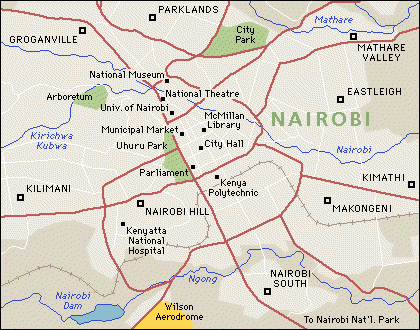
Some of the following maps are small cut-outs of maps that are no longer in print. The Nairobi Environs map covers a larger area from Kikuyu town in the northeast to the international airport in the southwest.
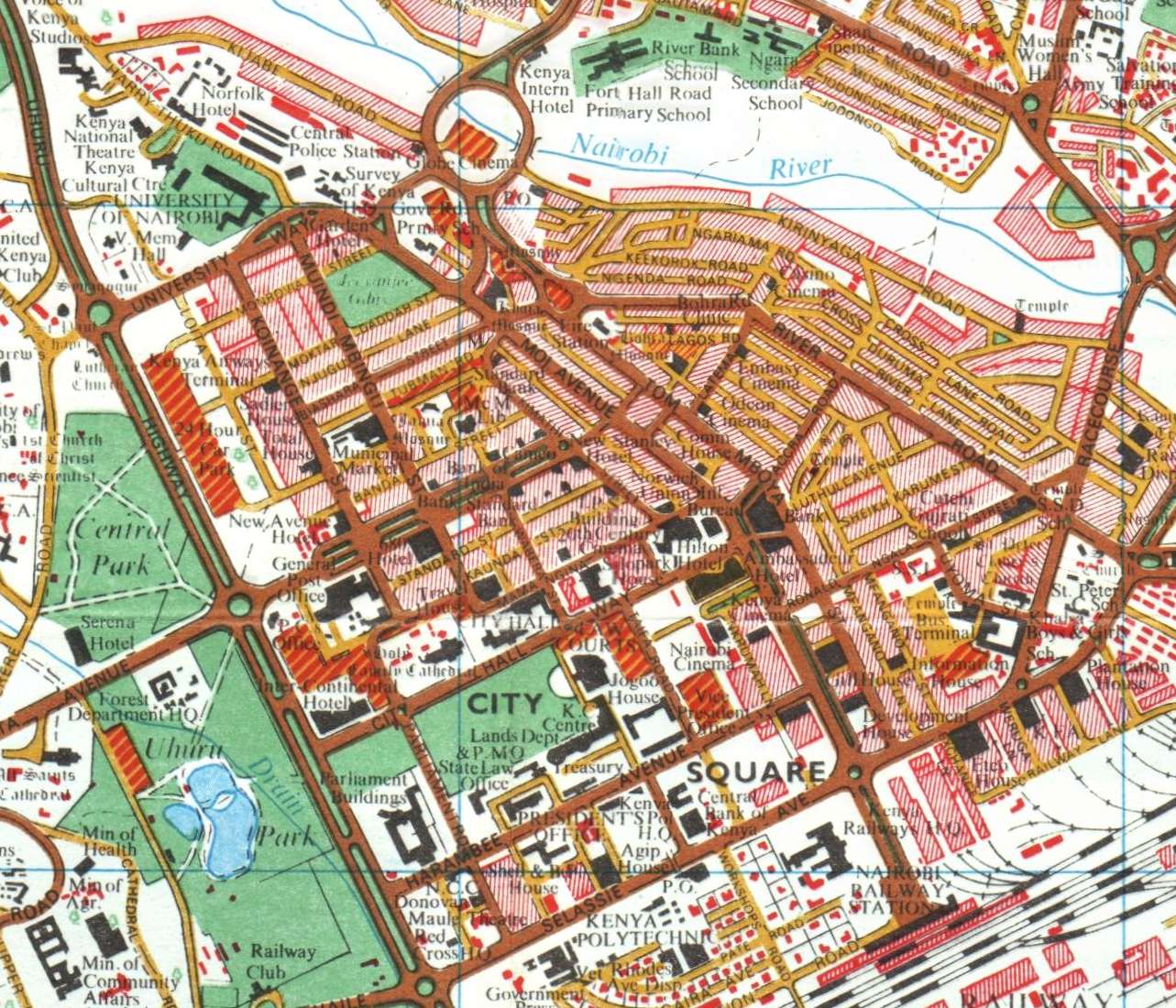
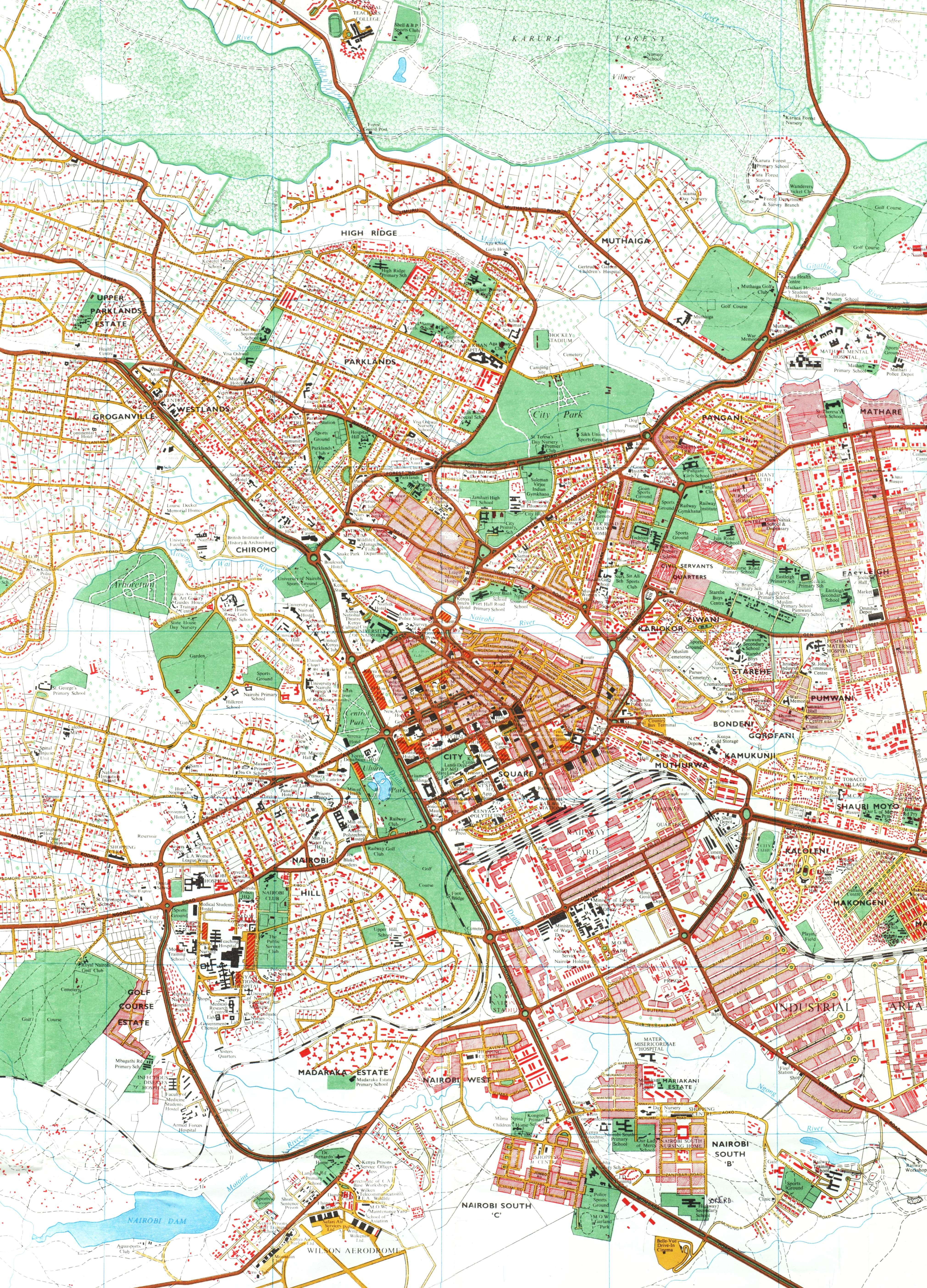
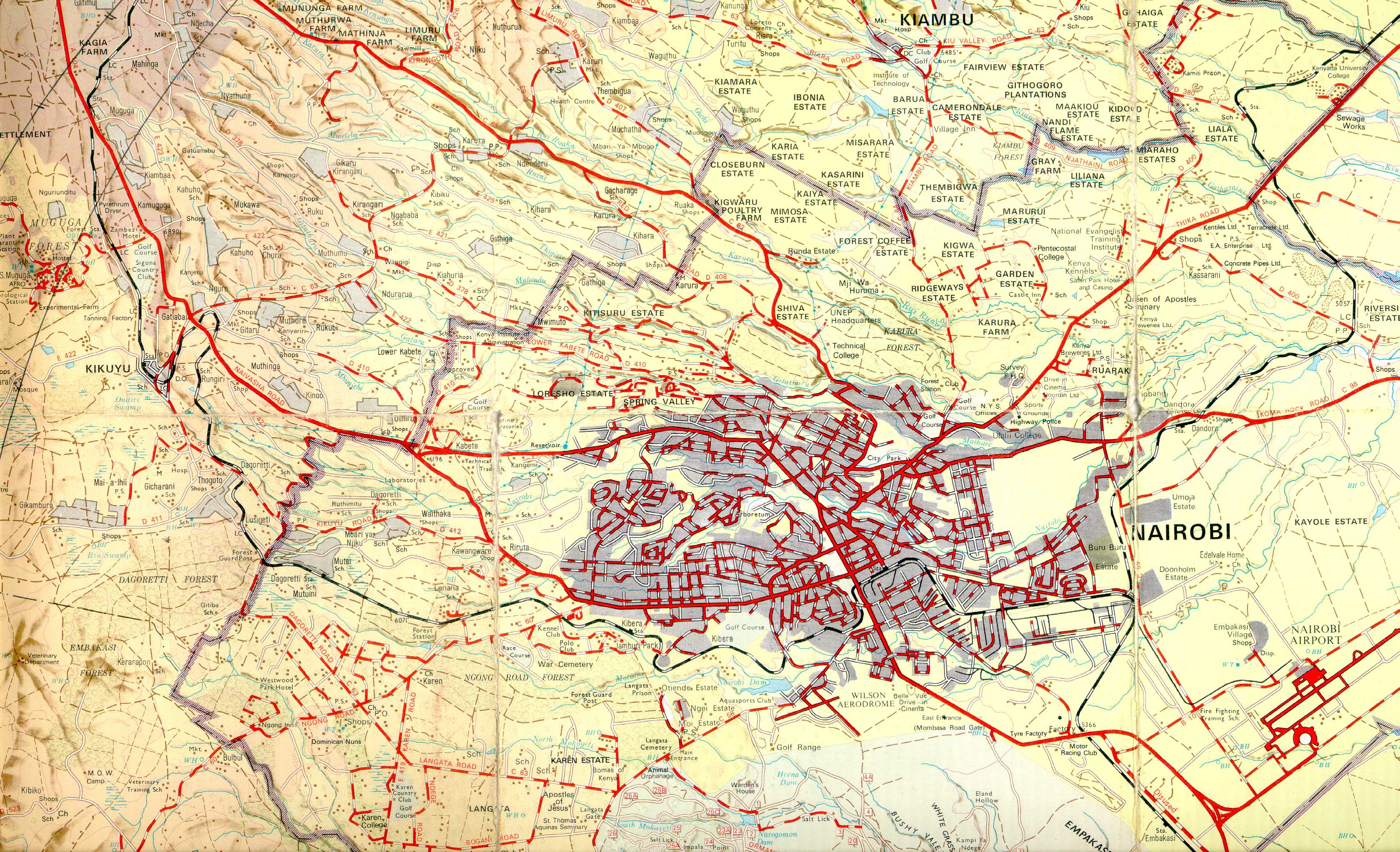
Nairobi center (282 KB); Nairobi (3.64 MB); Nairobi Environs (1.27 MB)
Directly at the airport obtain some cash from a Barclays ATM. The banks in the city close already in the afternoon (16 o'clock?), but the banks at the international airport are still open late into the night. Make sure that not too many people watch you when getting cash. Do not count the money. Put it in your pocket immediately.
Some airlines, e.g. air France and Sabena, require still a separate confirmation of the return flight at least 72 hours before takeoff. Unfortunately one must take this seriously. In 1996 I was actually refused my OK Air France return flight, because I did not know this and therefore had not confirmed the flight. Therefore inquire, if you are not sure, whether you must confirm your return flight. If you have to, then you try to do it immediately after arriving. Tell them that you are travelling in the bush during your entire stay and can therefore not confirm your flight later. Demand the confirmation code in order to be able to prove the confirmation. At least you can, at the same time, express your seating wishes or actually reserve your seat.
At the end of May there is a Muslim holiday (inquire in time about the exact date). 1st June is also a holiday, Madaraka Day (independence day). On this day the airports are often closed in the late morning for approx. 1 hour because of a military flyby air show.
A recommendation for some good low-price accommodation is http://www.shalomhousekenya.org/ (GPS waypoint NAISHALOMH). You find it by driving out on Ngong Road until Dagoretti Corner, a large, elongated roundabout. Keep left and continue for another 500 m. A small road goes right. It is unpaved, but has a name sign: St. Daniel Tomboni Road. There is also a big sign for Shalom House there. It is the third gate on the right side.
Activities:
Shopping etc. in Nairobi:
Tanks: Always fill up, if the tank is less than 2/3 full or a longer distance has to be covered, particularly on the journeys Baringo – Samburu, Mombasa – Nairobi and Masai Mara.
It is possible to go to Nakuru and visit Nakuru National Park on one day. This requires driving off from Nairobi very early. You would then use the "back door" into Nakuru National Park, the gate near Lake Nakuru Lodge, and drive around the lake during the rest of the day. You would then arrive in Nakuru in the evening and spend only one night there. When driving off from Nairobi later, you could spend two nights in Nakuru and use one entire intermediate day for the tour around the lake, taking lunch in Lake Nakuru Lodge southeast of the lake at the hill slope inside the Park. Yet another plan is to stay overnight in Naivasha, which is recommended if you have enough time and want to comfortably acclimatize yourself at the start of your journey.
From Nairobi drive in the direction to Naivasha/Nakuru, either along Uhuru Highway to the north through Westlands or through Langata and Karen, then northeast. The following mileage applies, if the trip odometer is set to zero on the Roundabout Uhuru Highway/Kenyatta Avenue (in the center of Nairobi).
Gas stations are at km 25 and along the entire route to Nakuru, so this is one of the exceptional routes where you can allow your fuel to drop to ¼ full before visiting the next gas station.
You can drive along the old or the new road. In 2005 the distance of Mai Mahiu (where the road to Narok branches off the old road) to Naivasha was bad. In 2002 the new road leading straight past Naivasha was rough, but still drivable at reasonable speeds.
If you want to visit the Naivasha Country Club, use the old road, even if it is bad, to avoid having to go back after branching off the new road. Anyway, the old road is more interesting and recommended, unless you are short of time, so at km 37 (GPS waypoint) branch 90° to the left in the direction to Narok onto the old road.
Attention: the turnoff from the new to the old road is easy to overlook. It is a paved road crossing underneath the new main road. There is a sign to Narok. To use the old road (recommended), turn off to the left here, otherwise keep driving straight.
The distance Nairobi – Naivasha takes approx. 2 hours. If you reach the Lake Naivasha Country Club very early (before 10-11 o'clock), then you could drive on to the museum "Elsamere" (Lioness Elsa) at the southern lakeshore, near the end of the road. Otherwise, if you have enough time, the lunch in the Lake Naivasha Country Club (Block Hotels & Lodges, formerly Lake Naivasha Hotel) nearer to the beginning of the same road along the southern shore of Lake Naivasha, or you could spend a night in the very beautiful hotel. This is particularly recommended, if you just arrived in Kenya and want to acclimatize and enjoy the beauty of the country before travelling on.
The following picture shows the old road on the eastern side. The new road passes farther to the east of Naivasha and is connected to Naivasha by another road (not shown here), which branches off in Naivasha to the east, but then veers off southerly for quite a distance before it meets the new road. To Nakuru you can also continue on the old road, which meets the new one in the north.
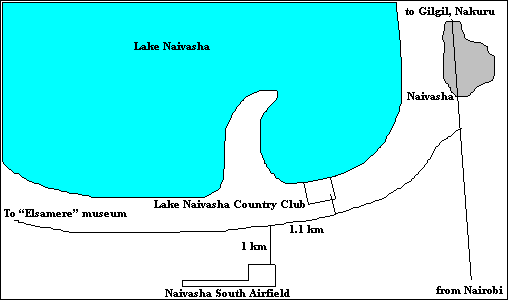
Objects of interest:
You can see the animals on Crescent Island from the boat. You can also land on Crescent Island for a walk and let yourself be collected again a few hours later. The boat ride across the lake is recommended. The boats and drivers are hired from the hotel.
From Naivasha drive directly on the main road towards Gilgil – Nakuru. The distance Naivasha – Nakuru takes 1½ to 2 hours on the paved, but rough road. In 2002 there were no dangerous potholes, but the road was rather rough and required reduced speed (50 km/h) in a small Suzuki Sierra off-road vehicle. Bigger off-roaders with softer suspension can probably go at a higher speed.
If airplane passengers have to be collected from Nakuru-Lanet airfield, the airfield is approx. 15 km before Nakuru (southeast of Nakuru town). Coming from Nairobi, turn right just behind a BP petrol station, drive around the petrol station, then some 2 km to the east. The last garrison entrance bears the name "81. Tank Battalion". Here you have to turn right and pass through the military post and barrier. After a short distance, about 50 m, keep left and keep driving along and to the left of the wooden fence. Around the end of the fence you enter the airfield to your right and see the abandoned club house.
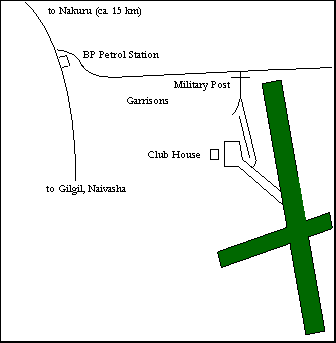
In Nakuru stay in the Nuru Palace or in another Hotel. Alternatively you can plan differently and stay in the much more expensive, but quite attractive Lake Nakuru Lodge inside the nature reserve, which is reached via a road branching off the main road on the other side very near the BP petrol station and leading southwesterly to the park entrance and the lodge.
In Lake Nakuru National Park drive around the lake on the western side. Coming from Nakuru, drive straight to the south from the center of town. From Nairobi or from the airfield drive to the southern gate near Lake Nakuru Lodge (GPS waypoint). Follow the signs and drive on the paved road to the west for some kilometers until you reach the gate. Alternatively there is Lanet Gate on the eastern side of the park, especially when you want to do a game drive to Lake Nakuru Lodge, which takes about one hour without stops.
Lunch or overnight stay can be in the Lake Nakuru Lodge, on the slope near the southeastern corner of the lake. If you have enough time and money, you can consider to spend two nights in the Lake Nakuru Lodge, particularly if these are your first nights and you want to acclimatize after your arrival in Kenya in a pleasant environment.
In the far south of the park there is a camp site directly next to the Makalia Falls (GPS waypoint).
At the main street at the northern edge of the town centre of Nakuru there are two roundabouts. At the second, westerly roundabout the road to Marigat branches off toward the north, crossing 5 rails, then hitting a road which you enter and follow to the left (westerly at first).
The following mileage applies, if the trip odometer is set to zero on this roundabout. The trip from Nakuru through Marigat to Baringo (Kampi ya Samaki = fish camp) lasts approx. 1½ h on the good paved road, but keep watching out for a few bad pot holes and speed bumps along the way (last checked in 2002).
Immediately after the roundabout there is a gas station on your right, but after 40 km, 2 km before the equator, there is still one last Kobil gas station (GPS waypoint). There is also a surprisingly cheap, but somewhat unreliable gas station in Marigat (GPS waypoint), which you should always use, because the gasoline is still cheaper here than in the Lake Baringo Club.
At Kampi ya Samaki a paved road branches to the right. After approx. 1 km you reach the Lake Baringo Club (Block Hotels & Lodges) after passing the airfield on the right side. You have to pay KSh 100 per person and KSh 50 per car as a nonresident at a road block.
Directly to the left, next to the lodge, there is a private camp ground, Roberts' Farm, with restaurant and bar. A few huts can also be rented there.
Except for the coast, this may well be the warmest place of the entire journey. Activities:
An alternative or additional destination is Lake Bogoria (formerly Lake Hannington) with its flamingos, hot springs and geysers, which is reminiscent of the Yellowstone park in the USA and which has the rare Klipspringer gazelle. The shortest way from Nakuru to it, via Mogotio, is bad and not even in parts passable at any reasonable speed. The paved road from Marigat, which was new in 1999, is faster and more comfortable. There is also a good and relatively inexpensive lodge.
Maralal is a suitable point for an overnight accomodation, at about half the distance between Baringo and Samburu. However the lodge is rather expensive and does not offer anything really interesting, except perhaps a walk in the sanctuary (see below). Also you would have to drive a considerable distance to the north from Kisima on the main route, some 45 to 60 minutes, in order to reach Maralal, and later back again.
It is also possible to drive the entire distance Baringo – Samburu on one day and omit Maralal, which requires to start at or before 5:30 o'clock, in order to arrive safely before sunset with some buffer time to spare. This is not very easy, because some stretches can be driven only quite slowly. Please skip to the next subchapter for more details, if you want to do this. The rest of this subchapter applies to Maralal.
The map at http://www.laikipia.org/map-of-laikipia.htm shows a significant shortcut to Maralal that branches off to the north somewhere around Churo or between Churo and Mugie, which is probably not only useful when going to Maralal Lodge, but also to the Yare Camel Club. The map is probably reliable, but I haven't tested that route yet. I also got verbal confirmation that that road is usable.
Driving from Baringo to Kisima takes about 3.5 h. Add another hour if you go to Maralal. The following mileage applies, if the trip odometer is set to zero at Lake Baringo Club.
From Baringo drive back onto the main road and turn to the right/north. Turn to the right at km 16 in Loruk (some huts) onto an unpaved track. This leads you past the Lake with a few beautiful lookout points, then out of the Rift Valley, through Tangulbei, then Churo.
At km 116 (Mugie) the road meets route C77. Turn left to a northeastern direction through Kisima, then to Maralal.
At km 135 you drive through the small town of Suguta lol Marmar (also called Sukuta Marmar). At km 156 near Kisima do not turn right towards Wamba, but continue straight and drive north to Maralal.
In Kisima there is an unpaved airfield directly to the left of the road. The Runway begins at the road and continues to the left (west).
A few kilometers before Maralal you pass by the Yare Camel Club, which is suitable for an overnight stay and has a restaurant as well. Toilets and showers do not always work well though.
A petrol station can be found in Maralal at the first roundabout. You need this filling station anyway, even if you don't want to go to the lodge.
To the lodge turn left. After approximately 1 km turn left into the track leading to Maralal Safari Lodge.
The lodge is located on the eastern side of a wooded hill, which is approx. 50-100 m high. The road to the airfield leads around the north side of the hill. The airfield is located on the southwest side of the hill, approx. 4 km in a straight line. After passing the small artificial lake on the right side and driving on for approximately 700 m, turn diagonally left to the airfield. Advice to pilots: the airfield is not particularly good. If the wind allows, land short from the northwest, because the first section is better than the rest.
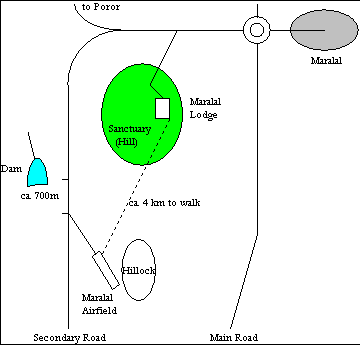
Special features and activities:
If there is still enough time, have a walk in the sanctuary, for example to the summit of the small hill. Beware of buffalos in the bushes! If you do not see them in time, they attack unexpectedly.
Alternative accommodation is available approx. 2 km south of Maralal town at Yare Camel Club & Camps, Malcolm J. Gascoigne, phone Maralal 0368-2295.
One possibility is to drive off from Baringo at or before 5:30 o'clock without breakfast (recommended, if you want to omit Maralal). The distance still needs to be covered without longer breaks. For the entire distance you should plan 12 h, with the detour via Samburu Oryx airfield, 12:30 h. You also need some buffer time, for example to change a tire.
My own measurement in 2011 was:
| Segment | Distance | Time |
|---|---|---|
| Baringo – Kisima | 140 km | 5:30 h |
| Kisima – Samburu | 146 km | 6:10 h |
| Gesamt: Baringo – Kisima – Samburu | 286 km | 11:40 h |
The complete route is: Baringo – Loruk – Tangulbei – Churo – Mugie – Sukuta lol Marmar – Kisima – Lodungokwe – turn south before Wamba – near Ngotogongoron or Ngutuk Engiron (school) – Samburu west gate – if necessary: Samburu Oryx airfield – Samburu Lodge. The track from Mugie to Kisima via Sukuta lol Marmar is bad and takes a lot of time if you don't want to risk breaking the car.
At Kisima you can assess your progress and, if you find that you are late, decide to turn off to the north towards Yare Camel Club or the expensive Maralal Lodge and spend the night there.
Another possibility, when you run out of time, is to camp on the way. One possibility is a dry river bed, of which you cross several as you approach the Samburu west gate in the afternoon. There is, however, a danger of flash floods, which can occur even in perfectly dry weather if it rains upstream in the mountains. Camp in the river bed only if you are certain that a flash flood is impossible, for example when you have the originating hills in sight and the weather is perfectly dry and clear. Otherwise you can still use a dry river bed to drive away from the track far enough not to be seen or heard, then drive out of the river bed into the bush and camp there. The disadvantage is that, in the case of a flood, you cannot take the same way back and have to fight your way back through the bush, which can be very difficult and time-consuming.
Before you decide on a camping place, listen carefully for the sounds of a nearby settlement. If you hear those, move somewhere else. You should also be very careful not to be seen or heard by anybody, and you should, if you do not feel completely safe, put somebody on guard.
If you lose a lot of time and cannot cover most of the distance in the day, you can look for christian missions and ask to be allowed to camp there. But there are probably none near your destination of Samburu Game Reserve.
Another untested option is to drive up to a Samburu manyatta (village) and ask the chief for permission to camp near the manyatta. Keep a little distance from the manyatta to avoid fleas, if possible. When you have the impression that the people are friendly, you can make this a social event by inviting the people into your camp and chatting with them, but this makes sense only if there is at least one person among them who can speak English reasonably well.
This option may be the only good one in an emergency, as it is difficult to judge what could happen when you camp out on your own and cannot check the area around your camp thoroughly. It contains the risk, however, that you happened to unwittingly choose a gang of robbers harbored or befriended by that manyatta. I cannot tell how big the risk is that you are robbed more or less by the people whose hospitality you asked, but it is certainly possible.
In the next morning you can then reach Samburu Lodge in a short time, possibly still have breakfast there, then have a shower and rest.
One other point to watch out for is fuel. The Suzuki Sierra can cover this distance only marginally with one tank, but most other off-road vehicles, including the much more thrifty Suzuki Maruti Gypsy, have no problem with this distance. However, you want a full tank before you leave.
It is possible to find some fuel in the villages along the way. There are no gas stations, but some people in the villages keep some fuel and will usually sell you some. I've done that in Kisima once and was actually asked a far too low price, given the circumstances.
Airfield description: Samburu Oryx
Position of center of runway (degrees and minutes): N0 36.589 E37 31.806
Altitude above sea level: 3270 ft = 997 m
Runway direction (relative to true north): 155°/335°
Runway length: 658 m
Runway surface: gravel, new and smooth in 2006
Steep or curved approach to runway 16 and curved departure from runway 34 because of nearby hills on the approach path.
An approach to runway 16 over the hills was easily possible in a Cessna 182 with full flaps, little power, and some headwind. An alternative is a curved approach with a short, straight final. The other alternative would be a downwind landing, but the runway isn't very long.
The Samburu Sopa Lodge is 700 m SW from the airfield. Unfortunately there is no taxiway to the lodge.
My personal opinion is that it might have been easy to use a slightly different runway direction like 135°, that would have avoided the hilly approach problem, and perhaps put the runway closer to the lodge as well. And add a taxiway to the lodge to add this place to the lodges favored by pilots, like Keekorok, Kilaguni, Meru Mulika, and others, where one can reach the lodge without requiring extra transport.
Samburu is actually the name of the local tribe. The Samburu are close relatives of the Maasai and speak the same language (Maa).
The area is relatively warm and dry, though still some 3,000 ft above sea level, with hills reaching up to 5,000 ft, so you find species that are particularly adapted to survival without water, like the beautiful Oryx antelope that can survive without drinking water by means of very efficient kidneys and its ability to dig out roots that contain moisture.
You also find species like the Grevy Zebra, the Gerenuk (giraffe gazelle), or the reticulated giraffe, that do not exist in cooler, more moist areas like Masai Mara. In Samburu you find, with a lot of luck, the rare and nocturnal Greater Kudu, a magnificent antelope that often appears to move in slow motion.
Of course you also find the big, well-known animals like elephants, lions, leopards, and cheetahs. The river is infested with crocodiles. Entering the river is a ticket to hell, because the crocodiles will immediately approach and probably kill and eat anything smaller than an elephant or a hippo that makes noise in the water.
Typical vegetation is thorn bush savannah with some fire resistant trees. The sandy ground is thinly covered with grass. Along the rivers you find riverine forest belts with bushes and trees like the water-loving Acacia tortillis, the fever tree that was suspected to cause malaria before people discovered the anopheles mosquito and the plasmodium parasite it carries. It is also the main cause of flat tires because of its incredibly light, very sharply pointed, yet hard-like-steel thorns that are, for good measure, somewhat poisonous. The tree needs these thorns to deter animals like giraffes, elephants, and gerenuks from devouring its apparently tasty leaves and twigs, in which it doesn't succeed as well as in flattening tires.
The following kilometer figures apply, if the trip odometer is set to zero in the Maralal Safari Lodge. If you didn't go to Maralal, you may have to do a little calculation to correct for the offset, but since nowadays you should use a GPS anyway, this should not matter. The trip from Maralal to the Samburu Game Lodge lasts approx. 6 hours.
Drive off early because of the long distance. Branch off in a southerly direction towards Kisima at km 24, keep turning left there, to the east, back onto the C78 via Lodungokwe at km 76. At km 83 you will see a branch to the right—do not use that. The southern route via Barsalinga is untested and probably hardly passable. Moreover, you would have to cross the Samburu River, which is probably impossible during most of the year.
Only just before Wamba (big, conspicuous mountain range) at km 114 on the C79 turn right towards Archer's Post and Isiolo (there was a sign in 2000) and drive to the south.
In case of doubt you can drive from there up to the main street A2, then to Archer's Post, and reach Samburu Lodge from the eastern side.
Another way is, however, well passable and much shorter. It is both beautiful and interesting. At km 125 the C79, leading first to the south, bends approx. 90° toward the east a few meters behind a concrete-reinforced ford and a conspicuous rocky hill. Approx. 50 m past the ford another track branches off to the south. The branch has a small signpost stone. Please click on the pictures to enlarge them.
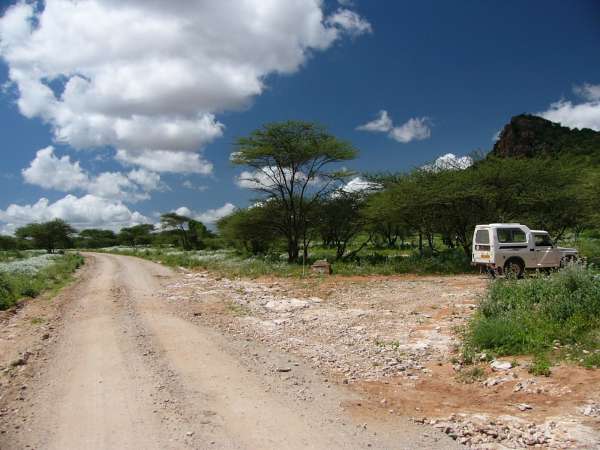
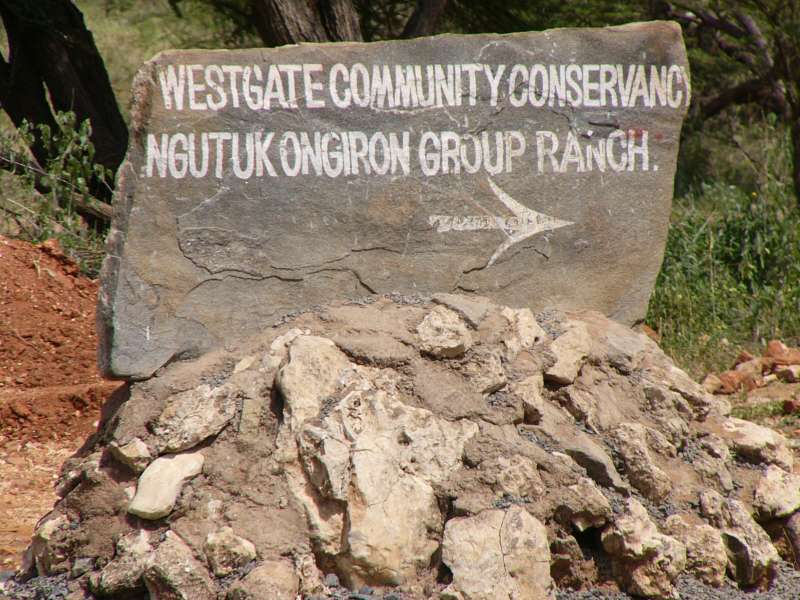
Turnoff south to Samburu west gate
The track, graded and widened in 2004, leads to Ngotogongoron or Ngutuk Engiron school (km 148, a few large barracks with corrugated metal roofs), from where it continues, not shown in most maps, to the west gate of the Samburu Game Reserve at the river. Where the way branches before the school buildings of Ngutuk Engiron, keep left.
The track passes just to the right of Sasaab airfield, which is also not on any better-known map and a difficult to spot from the road. You can see it on your left, usually grassy, but clear of trees and bushes.
At km 152 there is a branch to the left—do not use it. At km 168 you arrive at the west gate into the Samburu Game Reserve. Drive along the river and essentially straight, past the bridge (do not cross the bridge). At km 187 you reach Samburu Lodge, also sometimes called Samburu Game Lodge.
The actual place Ngutuk Engiron, according to some maps, is located further southwest, directly at the river. On this route you don't reach it. The school is several km before this.
In the better cards a road past Ngutuk Engiron is shown along the river up to the gate and to Samburu Lodge. I flew over it in 1993 to investigate. It was visible, however it looked in parts very difficult to pass (some fords across tributaries) and was entirely invisible in some places. If you have tents, lots of time, and good off-road cars, if it hasn't rained in recent months, and if you're not afraid of the adventure, then you can try that route. Plan this for a longer time though, because you should consider camping one night along the way and should not book the expensive Samburu Lodge for this night, in case you don't make it in one day. If totally impassable, you can turn around, go back to the school and use the other way described above.
Samburu Lodge is approx. 1 km east of the bridge on the northern bank of Samburu River. The bridge crosses over to the south into the Buffalo Springs National Reserve and to the Samburu South airfield. Activities:
For the exit from Samburu/Buffalo Springs there is a shortcut, painted blue on the map below, which shows the eastern part of the two nature reserves. The exit meets the Isiolo road approx. 2.5 km north of the main exit, thus avoiding some stretches of the road where attacks on tourists occurred in and around the year 2000, but before Buffalo Springs Gate. The easiest way to find it is by using the GPS track named SAMBUEXIT. In a Garmin GPS receiver you can use the TracBack function. The route requires one river crossing over stone plates that may be unpassable after rain.

River crossing (waypoint SAMBUY) when the river is dry
But the river crossing comes early, so you don't waste much time by looking at it. If the river has some water and you cannot see the stone plates, but want to cross anyway, keep a little bit to the right.
At one or two points the track is almost invisible, but when you just drive on by means of the GPS, you will soon see it again clearly after 100 to 150 m at most.
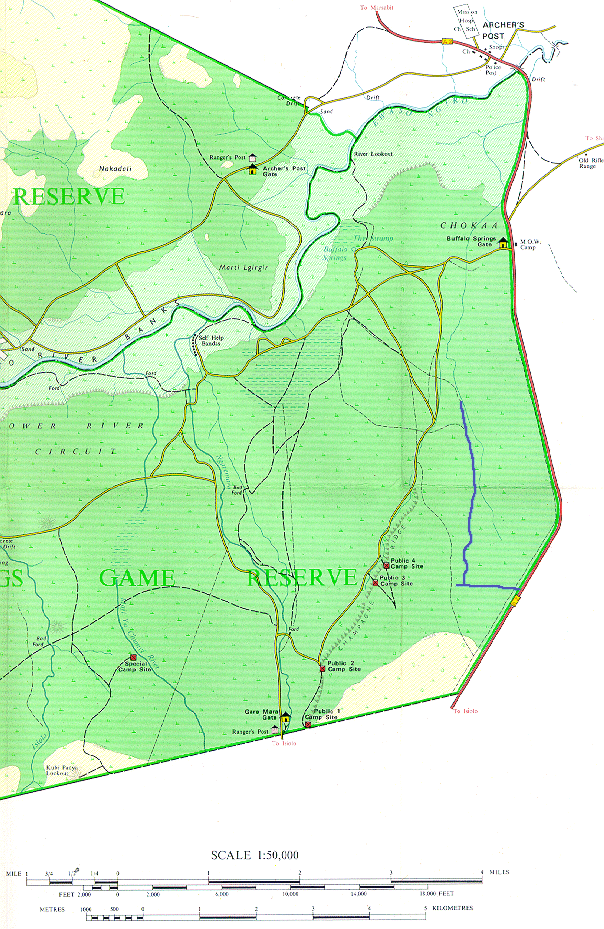
Map of eastern Buffalo Springs Game Reserve and Isiolo Road
It is not too difficult to find when looking for it far enough to the north. If, however, you drive to the public camp sites, then there is no further track towards the east. The printed black dashed track was not detectable and apparently no longer exists. Use a GPS receiver and the appropriate route from the Web page already mentioned, in order to find and use this route. Try no shortcuts here and don't try to omit any waypoint, because no shorter way seems to exist.
Returning from Samburu you can have a walk on Mt. Kenya with two additional overnight stops. For safety reasons the walk is not permitted for a single person, there have to be at least two. Drive around the mountain from Isiolo to the south through Meru in the direction towards Embu, to the left (east) of Mt. Kenya. The starting point is Chogoria, south of Meru, southeast of the peak of Mt. Kenya.
In Chogoria turn onto the climbing track towards the Mt. Kenya Forest Reserve and continue for approx. 20 km, until you reach the Meru Mt. Kenya Lodge. It consists of self service huts with gas cooking stoves. A bedroom for three cost approx. 2,200 KSh in 1997. A guide costs about 1,000 KSh on top of that. The slope is drivable only with a four-wheel-driven off-road vehicle, and even then it is still difficult. Slow four-wheel drive and a car with high clearance are necessary. The drive from Isiolo to Chogoria takes approx. 2 hours, from Chogoria to the lodge approx. 1½ hours.
Stays overnight in the lodge in your own sleeping bag, which must be warm enough, then you have the whole next day for hiking until the next night, which you spend in the lodge again.
Objects of interest
Problems
As an alternative, Marketing Alliance Hotels wrote: You should make a trip to Alliance Hotels – Naro Moru River Lodge on your next trip to Mt. Kenya, and include us in your web page! Visit us and see a little about Naro Moru River Lodge: www.alliancehotels.com . Email us at: alliance@africaonline.co.ke
Instead of or in addition to Samburu you can visit Shaba. However, the wildlife there is much less abundant than in Samburu. You can also drive from Samburu to Meru, which takes approximately 8 hours. If you like to experience a really bad road, then turn left in the center of Isiolo and drive to the left of and parallel to Isiolo airfield, then to Muthara and turn left there onto the tarmac route. After approximately 148 km starting from Samburu Game Lodge, some km before the end of the paved road, there is a branch to the left, which is marked by a brown, wooden sign (Meru Mulika Lodge or Meru National Park). Turn in there and continue 35 km to the Meru Mulika Lodge. The road leading down from the hills is bad, but becomes better down in the plain.
If you prefer to avoid the bad road and get there much faster, then continue to drive toward Meru town and follow the signs and your map to Meru National Park.
At the airfield of the Meru Mulika Lodge it was possible to buy good maps of Meru National Park in 1996 for 300 KSh.
Apart from the Meru Mulika Lodge there is a new, very good Leopard Rock Lodge and several campgrounds, from which Batherongi Camp Site distinguished itself by flowing water, toilet, shower and some bandas (huts) for rent. There is, however, no food supply. The Meru Mulika Lodge was not fully functional in 1996 (no water, no electricity, possibly no meals). Also new is the very expensive Elsa's Kopje Lodge.
The travel from Meru to Nairobi takes approx. 11 hours through Meru, Embu, Thika.
It is also possible to go from Meru to Kora National Reserve (four-wheel drive necessary) and visit the grave of Bwana Simba (George Adamson, his lioness Elsa and he himself are buried there). The road leads across the bridge across Tana River at the Adamson falls.
Leave early, the distance is long (325 km, approx. 9 hours). The way leads through the Samburu Game Reserve from Samburu Game Lodge back towards the west to the bridge, then across the bridge into the Buffalo Springs Reserve and on to Isiolo. (Leaving Samburu is described in more detail above in the chapter on Samburu.) Then one drives around Mount Kenya. Either side is possible. The western route via Nanyuki was almost perfect in 2004 and 2005.
You can drive the main road or you can branch off to Murang'a and go via the GPS waypoints KIGANJO – SAGANA – MURANGA – THIKAFALLS. If you drive this route in the other direction, going from Nairobi to Samburu, and want to take this route, the turnoff to Murang'a is at a sign saying something like "End of dual lane carriageway in 500 m". The road from there to Mugang'a was new and perfect in 2004. After Murang'a the road is worse, but still well drivable. At least 10 km before Nyeri (which you should bypass) the road becomes perfect again.
Finally you pass through Thika and reach Nairobi.
Climbing Mount Kenya with two overnight stays can be considered here. This would have to be planned in advance, as you'd need to book accordingly fewer hotel nights in Nairobi.
Pause with one or two nights in Nairobi.
Drive off very early! The journey lasts the whole day. On the Mombasa Road drive very defensively! In Africa one cannot always count on reasonable behavior of the other road users. The distance to Mombasa is approx. 500 km. Continue into Mombasa in a southeastern direction until you hit the main street, Digo Road. Turn right there and drive towards Ukunda in a southwestern direction. In Ukunda branch left towards the beach hotel road, then again left to the Leisure Lodge (sign with advertisement for the Casino) or any other lodge along that road.
The Leisure Lodge is divided into two sections—the lodge and the more expensive "Leisure Lodge Club". I recommend the club despite the steep price, because the lodge apparently only serves to train new employees and to keep employing the less able of them. The real efforts for quality take place in the club.
If the Leisure Lodge is full, then you can most likely find accommodation in one of the other, also very beautiful lodges. Activities:
Flight to Lamu. Lamu is a medieval town and was the largest port of the area 500 years ago. Lamu is interesting and worth seeing and quite photogenic in sunlight.
Lamu can also be reached by car via Malindi, but this takes a much longer time and is hardly possible in one day from Nairobi.
You can use the airplane again to fly back on the next or second next day.
The way leads back through Mombasa in the direction of Nairobi to the Kilaguni Lodge, a pause with overnight accomodation on the way to Amboseli. Kilaguni Lodge lies in the Tsavo West National Park. The earlier you drive off, the more time you have for the Tsavo nature reserve. Approx. 200 km from Mombasa branch left at the eastern Tsavo West main gate in the direction to Kilaguni Lodge and Mzima Springs.
There is another track to Kilaguni before Manyani, but it is clearly longer.
Tsavo National Park is not as densely populated with animals as some other nature reserves, but it is still very delightful in its own way. It is more original and perhaps more "African" than e.g. Masai Mara. The landscape is heavily shaped by volcanism and of an almost otherworldly beauty.
Activities:
A good alternative is the Kitani Severin Safari Camp, which is no more expensive than Kilaguni, but possibly nicer. The managers are Germans, and they are doing a fine job.
Since the way there and even the way out of Tsavo towards Amboseli passes by Kilaguni, the camp is good for safaris with and without aeroplane. The plane would land at Kilaguni airfield.
(For the route Nairobi – Amboseli see the next chapter, Amboseli – Nairobi.)
Drive off in time, the distance is long. It leads close to the Tanzanian border, then passes near by Oloitokitok and leads into Amboseli to the Amboseli Lodge.
Detail as of 2006: The road C103 from the western Tsavo West gate to Amboseli is closed for free traffic. Cars must drive in a convoy, and at a roadblock some way down the road you are required to take an armed Ranger aboard. There are two convoys per day. The first leaves the western Tsavo West gate at 8:30 o'clock, the second leaves at 14:30 o'clock. Cars that appear at the western Gate of the Tsavo West park after 14:30 o'clock are sent back and must spend the night within Tsavo West (in one the lodges or on one of the camp sites) or return to Mtito Andei, to the eastern Tsavo West main gate, or to Manyani. However, the convoy rule is apparently not strictly enforced any more. The armed ranger is enforced, and they tell fancy stories about cars being robbed after they get stuck in the mud, even if the weather is perfectly dry. The true reason is only that the ranger demands a tip after reaching the destination, and he will be very discontented if you only give him a normal tip like KSh100.
The unpaved road is partly very bad. You need approx. 5 hours to Amboseli. It hits the C102 a few km north of Oloitokitok, which you do not reach, because you turn right onto the C102. Then it turns off to the left (northwest) again approx. 3 km later to continue to Amboseli. After some kilometers you pass by the disused Airfield of the Amboseli Sopa Lodge (the former Kilimanjaro Buffalo Lodge) and the lodge itself, which may be good for a short stop. From there it is not far to Amboseli (approx. 1 hour).
Despite the convoy you should hold half a km distance from the car in front of you, such that you do not constantly drive in its dust wake, depending on wind direction and strength.
If you come from Tsavo through the Chyulu Gate, then spending the next night in the Amboseli Sopa Lodge (formerly Kilimanjaro Buffalo) between and outside of Tsavo and Amboseli parks is a little money-saving trick. Since you can only enter the first park in the afternoon, but have to leave the second one in the morning to get there from Nairobi and back, it makes sense to spend one night outside the parks in a place you can reach in the afternoon and from where you can reach the next park in the morning. For the KWS (Kenya Wildlife Service) parks you can only pay in 24 hour increments, and exceeding the 24 hours means paying for an extra day. Since 24 hours in Amboseli already cost $90 as of 2014, you need some time control to avoid wasting your money uselessly. The prices for the KWS parks have been raised time and again in recent years.
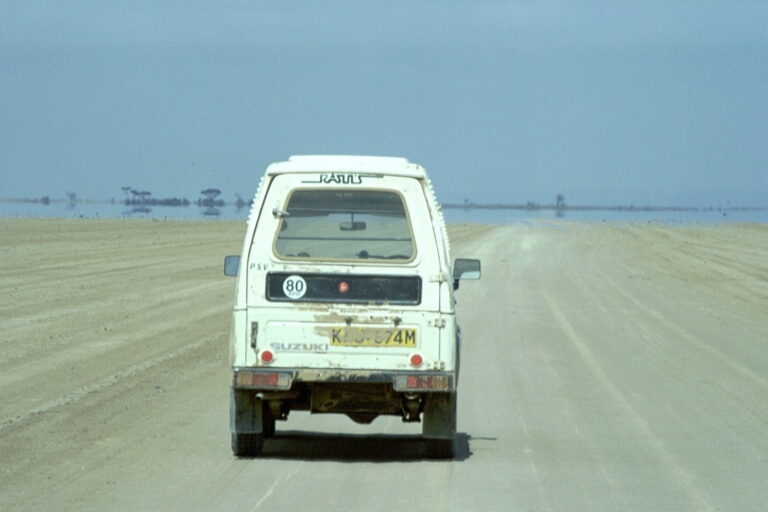
Fata morgana over the dry Lake Amboseli
If you plan to cover the distance from Mombasa to Amboseli in one day without overnight accomodation in the Kilaguni Lodge, consider that the road from the eastern main gate of Tsavo West at the Mombasa Road up to Kilaguni Lodge is in parts also very bad and requires a few hours. Plus you should not miss the second and last convoy. Therefore it is probably better to spend the night in Kilaguni and drive off in the following morning with the early convoy at 8:30 o'clock. This gives you, by the way, also the chance to have the magnificent sight of Mt. Kilimanjaro while driving. The mountain is sometimes free of clouds in the morning, but usually veils itself in clouds during the day.
The mountain has two peaks: on the right is the snow-covered main summit and volcanic crater Kibo (almost 6,000 m above sea level), and on the left there is the pointed side peak Mawenzi (approx. 5,000 m above sea level). Kilimanjaro is the biggest mountain in the world, measured from the surrounding plain.
Photo hint: If the mountain is free of clouds, then it is always a good idea to maneuver yourself into a position where you have the mountain behind another object. It can make the difference between a boring and a very unusual photo of, say, a normal zebra, when you take it in front of the snow-covered summit of Mt. Kilimanjaro. Do not drive on if you see a motive for a photo! Do not forget that the mountain can veil itself in clouds for days, such that you perhaps never see it again. Think of the old rule: "This photo never comes again."
Amboseli, at the foot of Kilimanjaro, is one the most popular, however also one of the most heavily visited, nature reserves of Kenya, famous for its elephant population and its wealth in other game. We stay overnight in one of the three lodges in the park, the Amboseli Serena Lodge, the Amboseli Lodge, or the new Ol Tukai Lodge.
Amboseli is often very dusty, such that you cannot wear hard contact lenses.
Activities:
Since 2010 there is a new route from Nairobi to Amboseli, which can be driven faster and easier than the routes described below. Drive towards Mombasa and turn right in Emali. Later turn right again to the gate. I have not used this route yet.
From Amboseli to Nairobi there are 4 approximately equally long (some 250 km) routes (stored in the direction from Nairobi to Amboseli, therefore the routes for the way back have to be inverted in the GPS):
In Namanga there are three petrol stations and some "hoteli", in which one can eat, drink and play with the girls. The latter is not recommended. The routes except route 4 continue on a smooth, paved road through Bissil and Kajiado to Athi River and Nairobi. Routes 1, 2, and 3 take 4 to 5 hours. Route 4 takes 6 to 9 hours.
Intermediate overnight stop in Nairobi.
Attention: If you have to confirm your return flight 72 hours before departure and haven't done it yet, do it now. Otherwise you risk not being taken on the flight (which actually happened to me in June 1996 with Air France).
The not quite correct spelling Masai Mara has become common. The correct spelling would be Maasai, which means something like: the people who speak Maa.
Before leaving Nairobi, load the Masai Mara track collection into your navigation device and, if possible, activate track guiding. This will help you not only to find the best way out of Nairobi, but also to find the best way to your destination in Masai Mara.
Starting in southeastern Nairobi, the wonderfully convenient and very fast way out is the new Southern Bypass road that is technically equal to a four-lane freeway in Germany. It cuts down the time to Mai Mahiu and Narok significantly.
You have to use the old road to Mai Mahiu. Branch 90° to the left towards Narok onto the old road. Without GPS navigation the turnoff is easy to overlook, but the old road is paved.
It is a breathtaking way down the steep rocky slope down into the Rift Valley. It is worthwhile to stop at a high lookout point briefly and to enjoy the view over the Rift Valley. Drive past an Italian chapel down into the valley.
In the valley you reach Mai Mahiu at km 147 and turn onto a paved road branching to the left, towards Narok. This road crosses the the Rift Valley over the foot slope of the Suswa volcano, and leads up the slope out of the Rift Valley on the other side.
In Narok behind the bridge at the lowest point, there is a large Kenol gas station on the left side. Fill up the tank there and eat, drink, and rest a little.
Narok is, apart from Ewaso Ngiro a few kilometers onwards, the last outpost of civilization before Masai Mara, the area being thinly inhabited by Maasai.
These are the times I recorded in 2015:
Nairobi – Mai Mahiu: 59 km, 1:27 h, average speed 41 km/h
Nairobi – Mai Mahiu – Narok (Kenol petrol station after the bridge): 150 km, 3:16 h, average speed 46 km/h
From there you can use at least three different routes to and from Masai Mara, all leading through Narok. One route to the Ololaimutiek Gate is not considered here because it is relatively long, and I have not driven there recently. It is still used, however, and may be worth a new try.
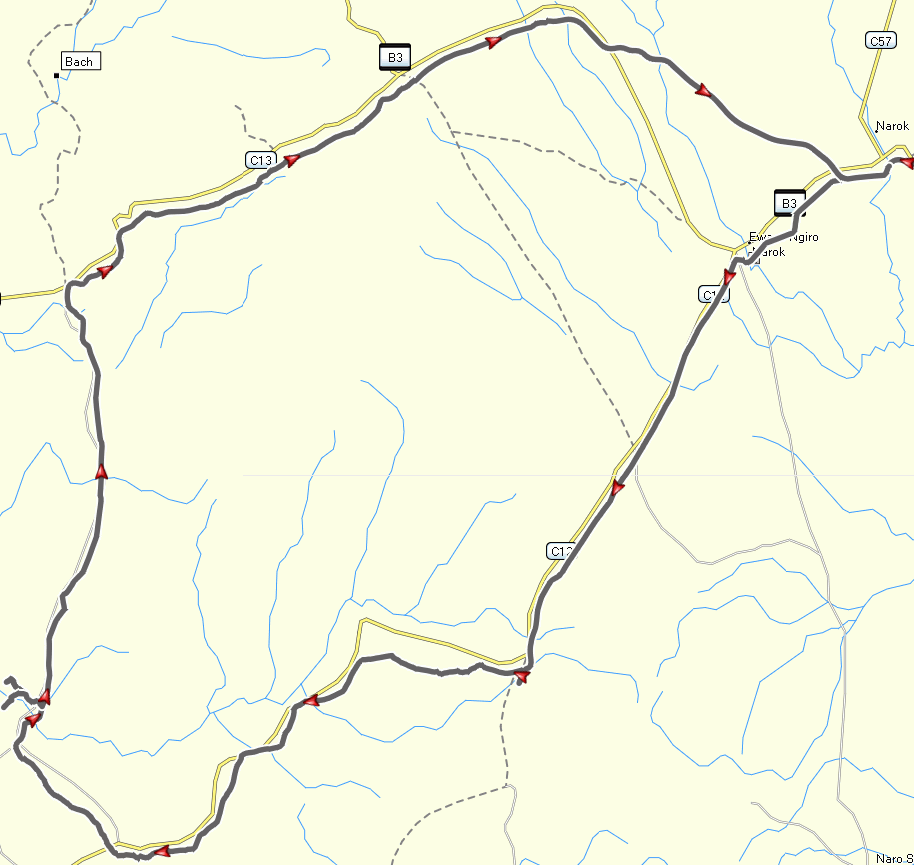
Narok – Masai Mara (2015)
I have used the two others in 2015. They are part of the Masai Mara track collection. The commonly used one leads through Sekenani Gate. However, the track from the end of the paved road near Ewaso Ngiro to the gate and beyond is very rough, and I drove large parts of it below 20 km/h to keep the risk low of breaking the car.
It is also very dusty. On the way to Masai Mara driving on the left side avoids most of the dust from other cars, because the easterly wind blows the dust away, but in the other direction dust is a very unpleasant problem.
In 2015 I recorded this for the route through Sekenani Gate to Fig Tree Camp:
Narok – Sekenani Gate – Fig Tree Camp: 122 km, 6:06 h, average speed 20 km/h
This includes some waiting time at the gate.
On the way back I used the remaining route. B3, C13, and C14 are the road designations as shown on most maps, including Google Maps. I will show it here reversed, as if driving from Nairobi to Masai Mara:
Narok – B3 – C13 – Ngorengore – Lemek – C14 – Aitong – Fig Tree Camp: 117 km, 3:40 h, average speed 32 km/h
As you can see, it is not only shorter, but a lot faster and less time-consuming. The main reason is that the C14 part has been graded recently and can be driven mostly at high speeds up to 50 km/h.
The short B3 part is an excellent, paved road. C13 starts out moderately good and deteriorates gradually, until the last part is terribly rocky. Big cars often drive fast over the rocks, but I do not dare to do that, because the road is not only rocky, but also uneven and bumpy at lower frequencies.
But then, near Aitong, you turn into the C14 track, and this was quite fast in 2015, except for a few river crossings. Most are unproblematic when it has not rained much. One requires rock climbing and well-calculated wheel placement, so it may be risky for inexperienced drivers. It is probably impassable for trucks, because it is too narrow, but the small cars we use, like the Suzuki Escudo, fits through these places easily.
Next to the track there are already many game animals, such that an occasional game viewing stop is worthwhile.
If you came via Aitong, do not enter the Masai Mara nature reserve. Instead drive into Fig Tree Camp on the northern side. This can save a good amount of money, as you do not want to drive around in the reserve that evening and probably not the next early morning either. Drive into the reserve only when you are ready for it.
If you come through Sekenani Gate, you have to pay the entrance fee to the Masai Mara Reserve. You can determine for how many nights you pay in advance. Recommendation: pay only for one night at first. You can still pay later in the nature reserve or at any gate.
Always keep the tickets, as they may be checked at any time in the reserve and when you leave it again.
If you drive from Sekenani Gate on small tracks (recommended when it is not too wet), these often branch. However it usually does not matter which way you take, as long as you maintain roughly the northwest direction (sun in your left front in the afternoon). If in doubt, keep a little towards the left side. Eventually you will get onto the main track to Talek Gate. Join it and continue approximately to the north.
The branch to Fig Tree is marked with a signpost reading "Fig Tree". The track leads straight down to the Talek River and to Fig Tree. At the river you find a parking lot and a footbridge to the lodge. Activities:
A very beautiful camping area with official camp sites can be found from Fig Tree as follows:
The campgrounds are not marked and hardly recognizable. Sometimes you can find places in which the grass is depressed, because there had once been a tent, or you find burned out fire places. In a few places you can find former toilets, which have, however, disintegrated and are not usable.
Sometimes in the morning a Maasai passes by and collects some money, particularly if he knows that someone uses the campground.
Occasionally some of the camp sites are occupied by tour companies. In that case you have to move up or down along the river to find another suitable place.
If you have more than one car, you can divide these in such a way that at least one car is on each side of the Fig Tree footbridge over Talek River, such that you do not constantly have to cross the gate. Instead you can keep a car on the internal lodge parking lot. coming from the external camp site you can then walk across the footbridge and use another car on the other side for game drives.
Close to Talek Gate there are also several enclosed, guarded campgrounds with different prices and qualities, but I do not consider these worthwhile.
It is important to reach the campground before dark, so that you can select a really suitable place. Therefore always drive off in time before 18 o'clock.
A flight without landing over the Ngorongoro Crater and the Olduvai Gorge in Tanzania could be possible. It takes around 3½ hours.
Either drive back again on the new road or, if you rose early enough, drive to Keekorok, then to the east, past the Airfield on the old Road in the direction of Ololaimutiek gate – Narok. The old road is somewhat longer (approx. one hour more), but also somewhat more beautiful. It meets up with the other one later again.
If your flight out of Kenya leaves on this same evening, do not take any time risks with your return trip, because you do not want to miss your return flight.
When leaving Kenya, you should be at the airport 3 hours before departure, only in exceptional cases at least 2 hours, because of unexpected delays and possible chaos at the airport. By being there early one can avoid this stress and be sure to catch the flight.
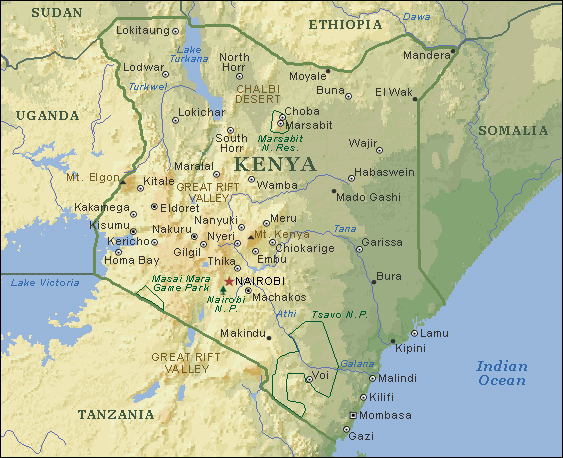
Kenya is a tropical country directly under the equator. A large part of our travel route leads however through high country. Nairobi, for example, is situated approx. 1,600 m above sea level. Thus these areas have a very pleasant climate. Here the average monthly highest and lowest temperatures in June for some relevant places:
| Place | Max/°C | Min/°C |
|---|---|---|
| Nairobi | 23 | 13 |
| Mombasa (coast) | 29 | 22 |
| Voi | 29 | 18 |
| Magadi* | 33 | 22 |
| Nakuru | 25 | 10 |
| Nanyuki (Mt. Kenya) | 23 | 9 |
| Narok (before Masai Mara) | 22 | 8 |
| Kisumu** | 28 | 17 |
| Lodwar** | 34 | 24 |
* Magadi is at the lake with the same name, southwest from Nairobi. We do not go there according to our plan, but could drive there if we have some time left over in Nairobi. On the way there is an archaeological excavation site (Olorgesailie) and an interesting landscape (in and out of the Rift Valley). The Magadi salt lake, deep in rift the Valley, is also interesting.
** not on our travel route.
In June most areas in Kenya have on the average 6 to 8 hours of full sunshine per day. Nairobi has somewhat fewer than 6. The air is substantially thinner in the high country, which has the consequence that sweat evaporates more easily, the lips dry out more easily, the number of red blood cells increases gradually, car and aircraft engines do not achieve their rated output by far and airplanes have in addition a higher take off and landing speed and therefore need a substantially longer runway. The air is usually also relatively dry, except after recent rains and except at the coast.
Central Kenya has two rainy seasons, the Long Rains around April and the Short Rains around October. During the Long Rains visits to Kenya are not recommended. The rains usually end in May, so that travelling in late May or June is usually not problematic and one normally doesn't get stuck in too many mud holes.
The main language of the country is Kiswahili, but almost everyone speaks at least a little English. This means, by the way, that most Kenyans have to be trilingual, because they also have to know their mother language, one of the approx. 72 main tribal languages in Kenya.
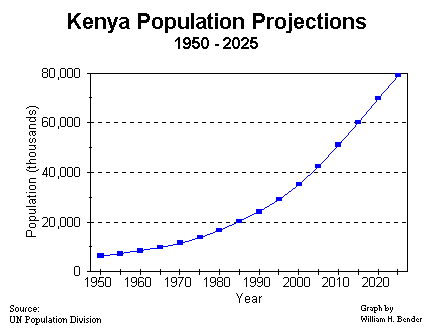
Extensive background information on Kenya can be found in the CIA World Factbook, section Kenya.
Please read the web site of the Kenyan Department of Immigration.
As of 2012 a visa is required. It can be bought on entry, for example on the airport.
The visa costs $50 or a similar price in €, £, or SFr.
The passport must be valid at least 6 months beyond the return journey date. (This is not always enforced.)
The following goods may be introduced duty-free to Kenya (as of 2001—please obtain current information if needed):
When entering from Germany, no inoculations are required. If entering from other African countries, however, (e.g. returning from a excursion into Tanzania), then certain inoculations are required, e.g. yellow fever.
The prices are, if not defined otherwise, in US$ for June (off-season). Starting from July and at most other times of the year the prices can be substantially higher. 1997 the average price for a double room in a wildlife lodge in the high season (thus almost throughout the year) was approx. $200 ($100 per person).
Fairview hotel, Nairobi, bed & breakfast (2003)
Single KSh5,200
There are three price classes. This is the lowest.
Shalom House, Nairobi (2007)
Single KSh3,200
Lake Naivasha Country Club (July 2001 high season prices)
| Room type | Full Board | Half Board | Residents/KSh |
|---|---|---|---|
| Single | $120 | $112 | 4,000 |
| Double | $153 | $145 | 8,000 |
Lake Nakuru Lodge (2003-2004)
| Residents/Season | Room Type | Single | Double | Triple |
|---|---|---|---|---|
| Non-Residents Low Season April-June except Easter /US$ |
Standard | 80 | 120 | 150 |
| De Luxe | 110 | 160 | 205 | |
| Junior Suite | 125 | 180 | 230 | |
| Senior Suite | 150 | 220 | 280 | |
| Non-Residents High Season July-March and Easter /US$ |
Standard | 160 | 190 | 245 |
| De Luxe | 190 | 230 | 300 | |
| Junior Suite | 200 | 280 | 360 | |
| Senior Suite | 260 | 370 | 480 | |
| Residents Low Season April-June except Easter /KSh |
Standard | 4,000 | 6,400 | 8,300 |
| De Luxe | 7,000 | 9,000 | 11,000 | |
| Junior Suite | 9,000 | 12,000 | 15,000 | |
| Senior Suite | 11,000 | 14,000 | 18,000 | |
| Residents High Season July-March and Easter /KSh |
Standard | 7,000 | 8,000 | 12,000 |
| De Luxe | 10,000 | 14,000 | 16,000 | |
| Junior Suite | 11,500 | 15,000 | 19,500 | |
| Senior Suite | 13,000 | 18,000 | 23,000 |
Children (3-12 years) sharing with parents: 50%
Children in own room: 75%
Christmas supplement adult: $30 / KSh1,500; child: $15 / KSh700
Merica Hotel, Nakuru (2997)
Single KSh3,250
Sundowner Lodge, Nakuru, bed & breakfast (1997)
Single Full board $50, half board $43.50
Double $110
Triple $143
Additional bed $33
Residents
Single KSh 800
Double KSh1,500
Triple KSh1,950
The Ark (1999)
| Room type | 5.4.-30.6. | High Season | Residents/KSh |
|---|---|---|---|
| Single | $163 | $299 | 6,290 |
| Twin | $189 | $352 | 9,450 |
| Triple | $289 | $530 | 11,630 |
Children are only permitted starting from 7 years and pay fully.
Lake Baringo Club, by person in single, double or triple (1999)
Single $80
Double $122
Lake Baringo Island Camp, by person in single, double or triple, full board $63
Maralal Lodge, by person in single, double or triple
Half board: 54
Residents
Single KSh1,560
August/September 1997, by person
Full board $87.50
Additional bed: $40
Yare Camel Club (Maralal, 2003)
Single
Residents KSh700
Nonresidents $15
Samburu Lodge (2003)
Low season is from April 2 to June and November to December 16
Resident
High season
Double KSh7,290
Single KSh4,510
Low season
Per person KSh3,500
Nonresident
High season
Double
Full board $200
Half board $184
Single
Full board $160
Half board $152
Low season
Double
Full board $130
Half board $112
Single
Full board $104
Half board $95
Samburu Larsen's Camp
August/September 1997, full board, double $239
Bomen Hotel, Isiolo (2007)
Single KSh1,500
Kilaguni and Ngulia Lodges, by person in single, double or triple, full board
$38
August/September 1997, full board
Person $100
Additional bed $50
Petley's Inn (Lamu, as of 1993)
Single $30
Double $45
New Lamu Palace Hotel (associated with Petley's Inn, 2003)
Special reduced price on request was KSh2,000 per person, cash.
Amboseli Lodge and Kilimanjaro Safari Lodge, 2006:
| Non-residents $ | High season | Low season |
|---|---|---|
| Single | 117 | 80 |
| Double | 180 | 120 |
| Triple | 243 | 160? |
| Residents KSh | High season | Low season |
| Single | 4,300 | 3,000 |
| Double | 6,600 | 5,200 |
| Triple | 8,900 | 7,000 |
Ol Tukai Lodge (now a full service lodge managed by Wilderness Hotels), 2006:
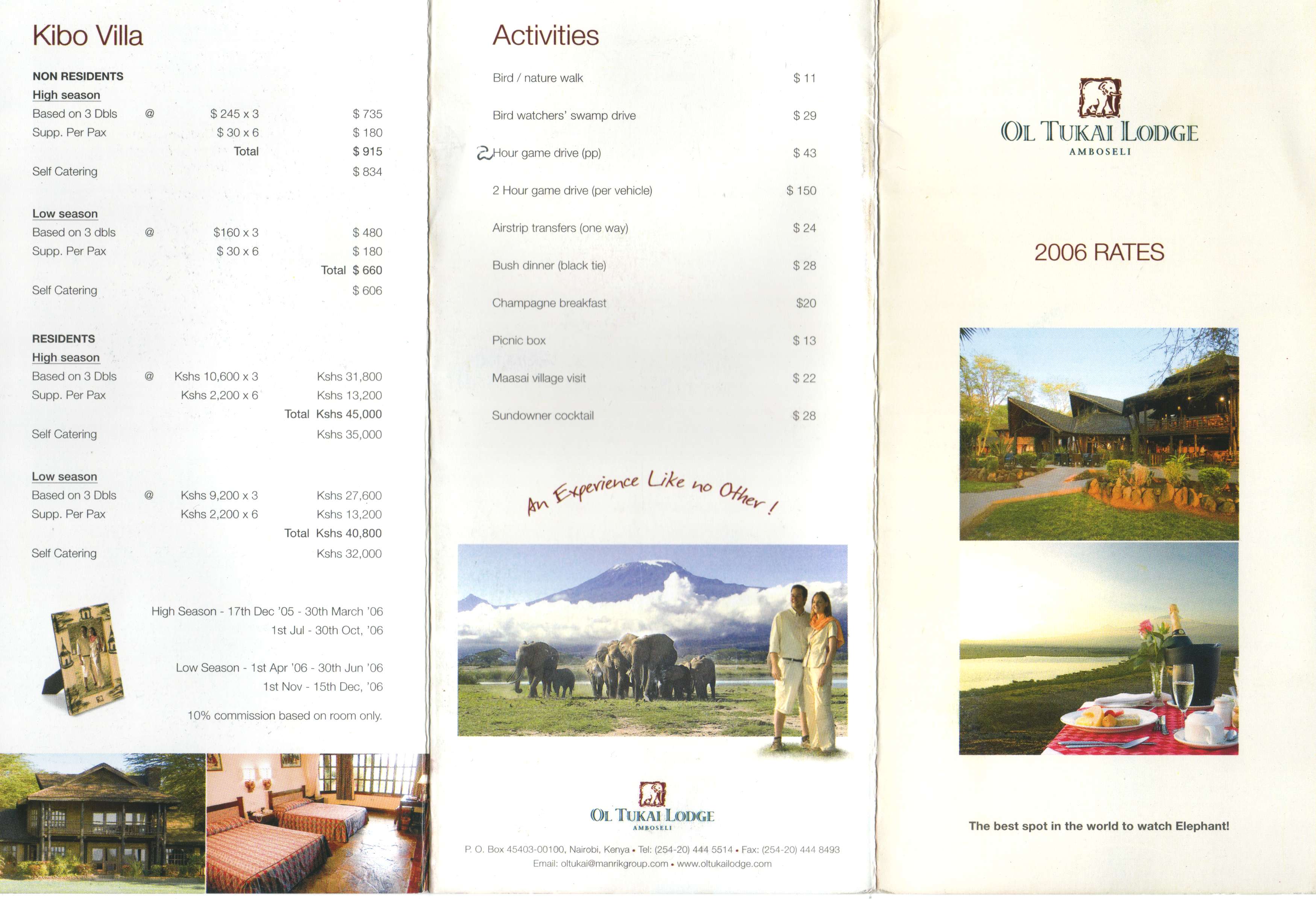
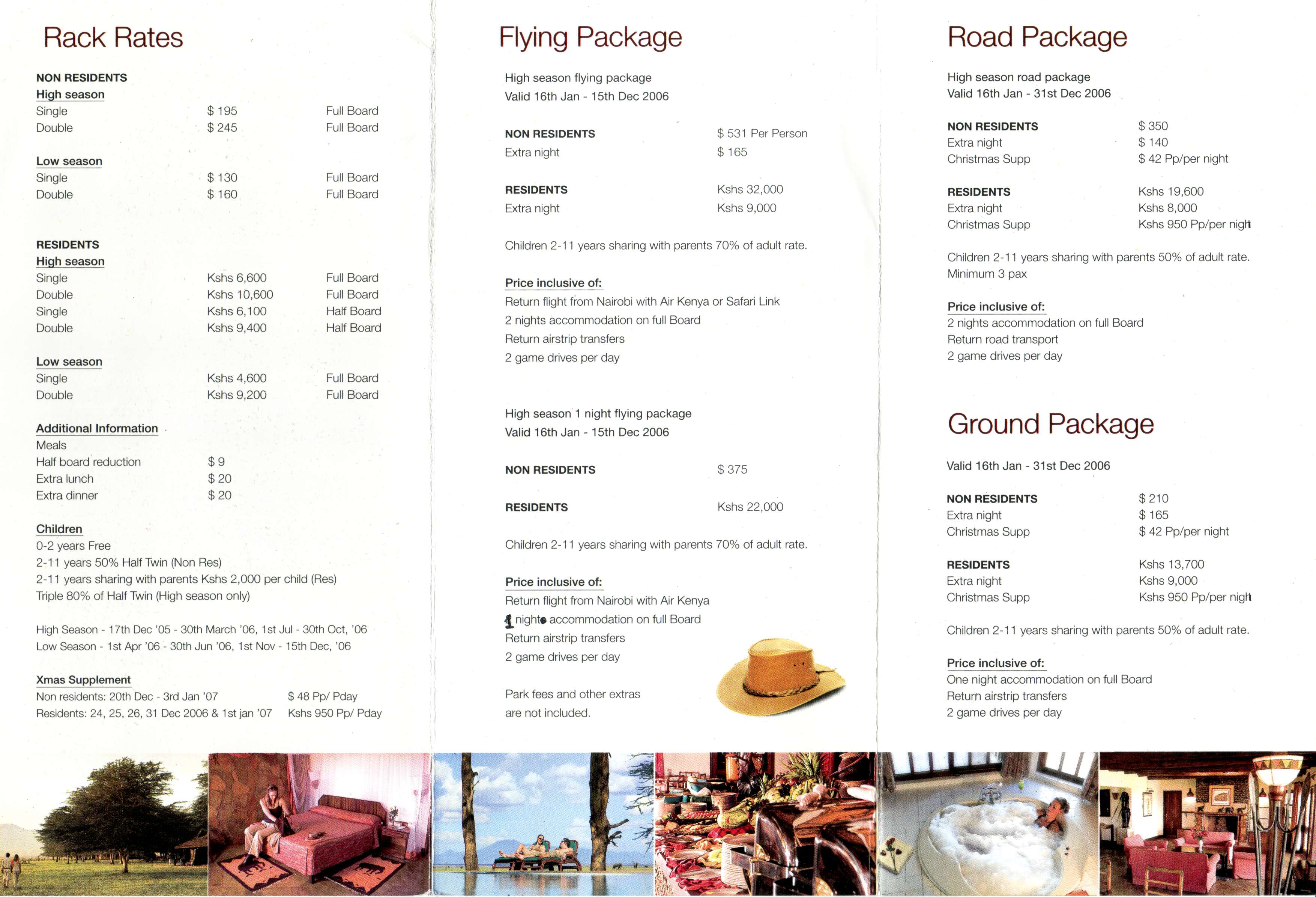
Ol Tukai Amboseli 2006 price list
Kimana Lodge, by person in single, double or triple, full board: $45
Amboseli Serena, Mara Serena, Samburu Serena (as of 2000, note: low season unfortunately only until May)
| Season | Space | Price |
|---|---|---|
| High Season | Twin/double | $225 |
| Single occupation of twin | $180 | |
| April, May | Twin/double | $140 |
| Single occupation of twin | $70 |
Half board reduction: $10 by person by day.
Amboseli Sopa Lodge (formerly Kilimanjaro Buffalo Lodge) 2006:
Low season, single $78, double $120
High season, from July, single $162, double $216
Mountain Lodge (as of 2000, note: low season unfortunately only until May, formerly African Tours & Hotels, since 1999 Serena):
| Season | Space | Price |
|---|---|---|
| High Season | Twin/double | $270 |
| Single occupation of twin | $200 | |
| Additional bed (Adults) | $115 | |
| April, May | Twin/double | $180 |
| Single occupation of twin | $90 | |
| Additional bed (Adults) | $77 |
Half board reduction: $10 by person by day.
Children under 8 yrs are not allowed in the Mountain Lodge.
Single resident June KSh2,900 (1999).
Tortillis Camp (Amboseli), by person in single, double or Triples, full board: $73
Mara Fig Tree Camp (2007, PDF 246 KB)
Mara Intrepids
15.12.2003-31.3.2004 and 1.7.2004-14.12.2004
Single 430
Double 585
Triple 815
Child 145
1.4.2004-30.6.2004
Single 235
Double 350
Triple 490
Child 90
Mara Explorer (high-price branch of Intrepids) 2004
Single $595, double $800
Mara Sopa Lodge, August/September 1997, full board, by person $108 in double room. Additional bed for child: $54
Mara Simba Lodge, August/September 1997, full board, per person $110
Musiara / Governor's Camp (click on rates)
Aero Club of East Africa, Nairobi, Wilson Airport (can only be used when accompanying
a member, prices of 2007)
Single KSh2,300
My favorite car rental company has closed shop.
Please check back here in the second half of 2018. I hope to have a new recommendation then.
All suitable off-road cars have a roof that can be opened for sightseeing and photography.
Apart from car hire there are regular and charter flights. As an example, see here the schedules and prices of safarilink (PDF, 257 KB, 2007).
The prices vary among different nature reserves. In 2019 the most expensive parks, Amboseli and Lake Nakuru, cost $60 for 24 hours plus $3 for a car, with Tsavo and others not far behind. Please see http://www.kws.org/tariffs.htm for the current prices of the KWS-operated reserves.
In non-KWS nature reserves (Masai Mara, Samburu, etc.) Kenya residents typically pay KSh1,000 per person per night and KSh300 to KSh500 per car per night (for small cars). Non-resident prices in those locally administered nature reserves closely mimic the KWS prices, and Masai Mara and Samburu can command the highest prices.
In 2019 Masai Mara cost $70 per 24 h for non-residents. It could be paid in KSh, but the exchange rate was unfavorable, some 10% higher than the interbank rate. It can therefore be advantageous to bring some dollars.
The KWS-operated nature reserves have given up their smart card system and now require electronic payment, either M-Pesa or credit card.
The entrance fees for KWS parks are calculated on a strict 24 hours basis. You pay the daily fee for each 24 hours or part thereof. Example: if you enter a park at 2:00 pm and leave it at 2:01 pm the next afternoon, the electronic terminal will inevitably enforce payment for two days. The times are taken automatically whenever the card is inserted into the terminal. Apparently the operator has no influence on this. This means that you should be sure to plan your exit carefully and with enough buffer time, if you're on a budget.
Keep the printouts, they contain all essential data. Keep them with you until you leave the nature reserve.
Special cases are the adjacent Samburu and Buffalo Springs National Reserves, which are not operated locally, not by the KWS. The rules for these reserves are changed every couple of years. 2019 I drove into Buffalo Springs and gave Samburu Lodge in the adjacent Samburu reserve as my destination. The rangers at the gate demanded payment for one night and said that it is valid for Samburu also. The next day I drove to the ranger post at the bridge on the Samburu side and paid for more days. These payments allow me also to cross the bridge for driving around without having to pay for Buffalo Springs again. The bridge post is sometimes unmanned and open.
The prices may differ somewhat and can change. For example, in Buffalo Springs a car costs KSh 500 per night, but in Samburu it is only KSh 400.
Iin 2019 the rate for non-residents in Samburu and Buffalo Springs was $70 per person per night. You can pay in KSh, but depending on their exchange rate that can be more expensive or possibly cheaper.
As many of the parks are essentially open in the sense that one could bypass the gates, the rangers sometimes check the tickets at the lodges and exchange information with the reception, which is probably effective. On one of my trips I had no bookings and no firm plans, so I regularly paid for one night when entering and paid for the rest later, after I had decided when I would leave. But I never got to paying at the exit gate, because the rangers always asked me for payment in the lodge already, usually on the day before departure, which I had by then announced to the receptionist.
Many, though not all, parks give a special price to students who can show an international student's pass. The same price often holds for children up to a certain age, for example up to 14 years. It happened to me twice on one trip that the rangers didn't have the matching tickets, and they ended up letting the student or the child in for free, because they couldn't issue a proper ticket. If you are a student, don't forget to bring along your student ID card.
The exchange rate in June 2019 was approx. KSh118 to €1 and KSh104 to $1. The main costs (lodges) are denominated in dollars. but you can usually pay in KSh for a realistic exchange rate.
Maestro (formerly ec) cards work in Barclays Bank ATMs, which hand out up to KSh 40,000, if you choose "Other amount" and type in the number. I presume that major credit and debit cards, like MasterCard and Visa, work just as well. They certainly work when paying in lodges.
Unfortunately I have been defrauded at two ATMs, one at the Nairobi international airport and one in Narok. Both ATMs were manipulated such that they do not disburse the full amount when you order a larger amount, KSh20,000 or more. Attempts to get the missing amount refunded in Kenya are a complete waste of time. In one case, however, one of my accompanying travellers managed to get the missing amount refunded by her home bank in Switzerland.
This kind of fraud probably only happens at ATMs next to tourist routes. ATMs in supermarkets or in the city center have always worked just fine.
The cheapest and most convenient method to get the local currency, the Kenya Shilling, is bitcoin. If you are conversant with bitcoin, you can change bitcoins through a Kenyan dealer on https://www.localbitcoins.com/ directly into Kenya Shillings in the Kenyan mobile payment system M-Pesa.
For this you need a Kenyan SIM card from the local mobile service provider Safaricom, the operator of M-Pesa. You can get it in Nairobi in the Safaricom office in the Galleria Mall on Langata Road. You have to provide your passport, and after obtaining the SIM card you should create your M-Pesa account right there. Also obtain a "data bundle" from Safaricom, so you have an internet connection on your phone while you travel.
M-Pesa has certain limits. The maximum account balance is KSh100,000. The maximum daily transaction value is KSh140,000. The maximum per transaction is KSh70,000. You can use a savings account, M-Shwari, to store an additional KSh100,000, but you have to feed the money through the M-Pesa account and obey its limits.
Please take your mobile phone along, if only for security reasons, but make absolutely sure it is switched off during game drives. Mobile phone use is also restricted in the Aero Club of East Africa, so please read their rules and obey them.
Kenya has several mobile phone service providers, the most well-known being Safaricom and Orange/AirTel. They may differ in prices for international calls, so if you plan to call home a lot, check their prices before you go and when in Kenya select the more favorable one on your phone wherever both are available.
See also: Pay as You Go Sim with Data Wiki
A few restaurants and hotels and, for example, the Aero Club of East Africa, have free Wi-Fi Internet.
If you want to be independent, however, you can do this (as of 2012):
There is also a way to obtain these settings automatically by a control SMS. Open the Safaricom menu by dialling *544# and find the point "Internet Settings" in the menu tree. It may be hidden in some additional settings sub-menu. I prefer to keep control over the settings, so I do not use this procedure, but it may be innocuous and convenient.
If you have a smartphone (Android, iPhone), check your installed apps for one named "SIM Toolkit". This app comes with the SIM card and cannot be installed otherwise. It contains several of the functions described below and makes their use easier.
To top up your prepaid SIM card from a scratch card, dial *141*number#, using the scratched number in place of number.
To find out your SIM card prepaid balance, dial *141# .
To find out the remaining Megabytes in your data bundle, send an SMS with the word balance to the number 450, then wait for an SMS with your balance.
These queries are free of charge.
You can find general information here:
Information about some nature reserves in Kenya can be found here:
You can find topical official security information here:
You can find the current exchange rate of the Kenya Shilling here:
These lists are not complete. Further information is available in various locations.
Hans-Georg Michna

Photo copyright © 2001 Thomas R. Wilke
Back to the homepage – Hans-Georg Michna
German version of this page, Kenya 1980-2000 photos
Kenya travel reports: 1999, 2000, 2002, 2003, 2004, 2005, 2006, 2007, 2008, 2009, 2010, 2011, 2012, 2013-Goma, 2013, 2014, 2015, 2016, 2017, 2018, 2019
